Showing posts with label great recession. Show all posts

Saturday, May 26, 2012

Republicans Do Not Care About The Deficit. They Care About Cutting The Safety Net for Seniors and Children


Republicans Do Not Care About The Deficit. They Care About Cutting The Safety Net for Seniors and Children

OK, so why does everyone think the deficit is out of control and a threat to the existence of the republic? Good question. It's probably way too late to pull us out of the rabbit hole we've collectively dived into, but anyone reporting on this really owes it to their readers to explain the basic political dynamics at work. So why do Republicans and Democrats both think the deficit is a problem?

    Answer for Republicans: They don't think the deficit is a problem. If they did, they'd favor tax increases, Pentagon cuts, and Medicare cuts, since even the most dimwitted among them knows that cutting domestic discretionary spending won't make a dent in the deficit. But they favor none of these things.

    Rather, they think federal spending on liberal social programs is a problem, and yammering about the deficit is a good way to force cuts to these programs. And there's nothing wrong with this. It's good politics. Why waste a crisis, after all? But anyone reporting on this issue really needs to be honest about what's going on. Republicans want to cut social spending. The deficit is just a handy cudgel to make this happen.

    Answer for Democrats: I'm actually a little stumped here. I think most Democrats understand that the short-term deficit really isn't a problem, and they also understand (I hope) that allowing the Bush tax cuts to expire and letting the economy recover will get us very close to eliminating the primary deficit (i.e., the deficit minus interest payments). If we do that, then publicly held debt as a percent of GDP stabilizes and the deficit problem becomes pretty manageable. The chart on the right from CBPP shows this graphically.

    In the longer term, Medicare growth is a problem — which is just another way of saying that healthcare spending in general is a problem. This needs to be addressed, but it needs to be addressed for its own sake, not just because it affects the federal deficit.

    So why have Democrats joined the deficit chorus? I'm not sure, really. I'd guess it's mainly just fear that they've been outflanked on the issue, and if they want to stay in office they have to yammer about it. But that's just a guess.

In any case, Republicans are wrong: we don't have a spending problem, we have an aging problem. As America ages, Social Security and Medicare are going to cost more, and unless you want to start killing off old people Soylent Green style there's no way to avoid this even if we do get a handle on rising healthcare costs. This in turn means we're going to need more revenue to care for the elderly. As Jon Cohn says today, "It's ridiculous to have a conversation about balancing the budget that won't even contemplate higher taxes."

A perpetually growing deficit will eventually drive up interest rates and slow economic growth, so it's something we should take seriously. But slashing social programs is exactly the opposite of taking it seriously. We need to let the Bush tax cuts expire, get out of Iraq and Afghanistan, keep working hard on reining in healthcare costs, and accept the fact that we're going to need to fund an aging population whether we like it or not. Do that, and all we'll need is modest discipline in the rest of the budget. The long-term deficit is a problem, but it's not a crisis

Perhaps the biggest piece of evidence that conservative Republicans only care about deficits as a political wedge is that they ran up historic deficits from 2001 to 2008 and did not rise one dollar in revenue to pay the deficit down. Mitt Romney has a deficit "reduction" plan, full of accounting gimmicks it will increase the deficit by at at least $3 trillion dollars while cutting the safety net and buying the newest toys for the military.

The Debt Increase Under Obama Is Largely A Result Of Bush-Era Policies

Trump on Romney: ‘He’d Buy Companies, He’d Close Companies, He’d Get Rid Of Jobs’

Wednesday, May 2, 2012

Romney Friend and Donor From Bain Has Wacky Urban Myths To Explain Great Recession


Romney Friend and Donor From Bain Has Wacky Urban Myths To Explain Great Recession

Income inequality in the United States has skyrocketed over the last several decades and especially since the Great Recession, so much so that it is now worse than in Ivory Coast and Pakistan. It may even be worse than it was in Ancient Rome, a society built on slave labor.

That income inequality is crushing the middle class and its political power. But don’t tell that to Edward Conard, a top donor to presumptive Republican presidential candidate Mitt Romney who gained notoriety during the campaign as a million-dollar mystery donor who set up a shell company to shield his identity. Conard, a former director at the Romney-founded Bain Capital, is working on a new book in which he argues that income inequality is a good thing, and what the U.S. really needs is more of it, the New York Times’ Adam Davidson reports:

    Unlike his former colleagues, Conard wants to have an open conversation about wealth. He has spent the last four years writing a book that he hopes will forever change the way we view the superrich’s role in our society. “Unintended Consequences: Why Everything You’ve Been Told About the Economy Is Wrong,” to be published in hardcover next month by Portfolio, aggressively argues that the enormous and growing income inequality in the United States is not a sign that the system is rigged. On the contrary, Conard writes, it is a sign that our economy is working. And if we had a little more of it, then everyone, particularly the 99 percent, would be better off. This could be the most hated book of the year.

Conard instead argues that income inequality helps everyone because investors grow wealthy by creating products that benefit the 99 percent. Though that is certainly true to an extent, Conard’s line of thinking leads to the supply-side policies that are proven failures at “growing the pie” for everyone. The Bush tax cuts for the wealthy, for instance, were supposed to create jobs and spark economic growth for everyone. They did neither, instead saddling the nation with unsustainable debt and deficits that Republicans are now using to justify massive budget cuts to programs that benefit the lower- and middle-classes.

And while investors like Conard made luxuries available to some Americans, they also bankrupted companies and left workers without jobs, pensions, or health care. Bain Capital, in fact, made billions of dollars for people like Romney and Conard while bankrupting nearly a quarter of the companies in which it invested.

Further, Conard believes the financial industry — the same financial industry that sold “shitty deals” and purposely exploited consumers — isn’t to blame for the financial crisis. Instead, it was investors who created an “old-fashioned run on the bank” that created the crisis. That’s a view that, as Davidson notes, “is not shared by many analysts.” It is, however, a view that is shared by Conard’s favorite presidential candidate, who has admitted that he is “not concerned with the very poor” and has promised to repeal the Dodd-Frank Wall Street Reform Act that aimed at preventing another such crisis.

Conard is the perfect Romney friend. he has convinced himself that everyone of Wall St is a saint that really just goes to work everyday thinking of ways to improve the lives of average Americans. Rational people call it trickle down economics. Some how from 1940 to 1980 the U.S. had probably the greatest economic expansion in the history of the world with strong unions and no one on Wall St making 300 times that of most of the middle-class. The elite truly are different than you and me, they have far more delusions.

Republicans Wouldn't, Couldn't, Shouldn't Get Bin Laden

Tea Partiers Who Opposed Bank Bailout Take Campaign Donations From Bailed-Out Banks

Barack Obama Killed Osama Bin Laden. Period. It was a bold, even risky decision, but he made it.

Romney Defends Inequality of Opportunity

Ann Romney's tale of 'struggling': We 'learned hard lessons' living off our stock portfolio

Friday, April 20, 2012

Thanks Conservative Republicans For an Economy That Rewards The Wealthy at The Expense of Workers


Both charts show economic growth during Obama administration.


Thanks Conservative Republican For an Economy That Rewards The Wealthy at The Expense of Workers

The AFL-CIO has released its CEO Paywatch with 2011 data. So how do CEOs stack up against ordinary workers? Well, the average CEO of a company on the S&P 500 Index earned 380 times the average American worker's wage, with average CEO pay having increased 13.9 percent in 2011.

The highest-paid CEO in the country was Apple's Timothy Cook, whose total compensation was nearly $378 million. That's more than 11,000 times the average worker's income of $34,053. The 100th highest-paid CEO, Heinz's W.R. Johnson, had total compensation of more than $18 million, 543 times the average worker's income.

What we can't know is how much CEOs make compared with the workers in their own companies; however, that's something the Dodd-Frank Wall Street reform bill will soon require companies to disclose. And it turns out it might well be good for companies if transparency pushed them to bring CEO pay a little more in line with average worker pay:

    High CEO-to-worker pay ratios can reduce the performance of companies. Academic research has found that steep pay disparities hurt employee morale and productivity. Extreme disparities between CEO and employee pay also have been shown to result in a significant deterioration in the quality of products produced.

    In companies where CEO compensation is disproportionately high compared with that of other employees, CEO-to-worker pay disparities can cause high employee turnover and lower job satisfaction. Another study found that firms with high levels of CEO pay relative to other top executives also reduce performance.

Those results are in sharp contrast to the current corporate wisdom self-interested myth that CEOs are worth every penny, that these pay levels represent meritocracy and that lower-paid CEOs would mean companies being less effectively run. But you have only to compare current CEO-to-average worker pay levels to those in the past to see that there just might be a decent argument for doing things differently.

Whatever this is, it is not capitalism as most American understand it. The average American stills believes that people get ahead on merit. And are paid more based on merit. Instead what we have is very wealthy people giving each other huge sums of money just because. Just because they're friends. Just because they talk a good game. Just because they are connected. Not because they produce anything themselves. Most CEOs - not all - most do not even know how to make their products. They would not have a clue how to distribute anything. If they had to do the work of the average employee they'd be lost. Middle- managers do the actual day to day management of the company. Conservatives have made America into 17th century France. All we're missing is the crowns and fancy velvet clothes.

Mitt Romney's Noblesse Non Oblige

There's nothing wrong with being born with a silver spoon in your mouth. It's what you do with that good fortune that matters. And that is at the heart of Mitt Romney's problem with the American people. With his proclamations and policies, the same man who denounces President Obama as "out of touch" and "Marie Antoinette" shows his aloof detachment and stunning incomprehension of the struggles Americans face every day. And yet, they don't begrudge him either his privileged past or financial success. Instead, they just want him to acknowledge the debt he owes to the society that made it possible.

Tuesday, December 6, 2011

Why is Newt Gingrich Winning Over Republicans? Because He is The Kind of Nasty, Corrupt, Idiotic Anti-American That Conservatives Feel Most Comfortable


Why is Newt Gingrich Winning Over Republicans? Because He is The Kind of  Nasty, Corrupt, Idiotic Anti-American That Conservatives Feel Most Comfortable 

It figured that a Republican presidential primary race defined by nothing so much as a taste for cruel and unusual politics would eventually see Newt Gingrich emerge as the cruelest and most unusual contender. Sure, Michele Bachmann, Rick Perry and Herman Cain might strive for the lowest common denominator. But Gingrich would outdo them in that department, despite heroic feats of insanity, stupidity and sex scandals by the other three. And so he has, emerging as the default choice of a new breed of Republican so extreme it would scare the bejeezus out of Barry Goldwater or Ronald Reagan.

In the same week that saw the former Speaker of the House become the most serious challenger to Mitt Romney, the Republican very few Republicans seem to like, Gingrich showed his true colors. As part of the ongoing GOP rant against organized labor, he stepped up with a proposal to fire school janitors and replace them with child laborers. Blaming “the core policies of protecting unionization and bureaucratization” for “crippling” children, Gingrich told a Harvard audience, “It is tragic what we do in the poorest neighborhoods, entrapping children in, first of all, in child laws, which are truly stupid.” Gingrich did not misspeak. He was serious in suggesting that “most of these schools ought to get rid of the unionized janitors, have one master janitor and pay local students to take care of the school.”

Even in a party where shamelessness is now considered a virtue, it’s unsettling that a man who collected $30,000 a month for an hour of counsel to Freddie Mac administrators would attack school janitors, who according to the Bureau of Labor Statistics earn a mean wage of $13.74 an hour, or $28,570 a year. In response to Gingrich, the American Federation of State, County and Municipal Employees said, “The people you want to fire and replace with kids? A lot of them are parents. That job puts a roof over kids’ heads, food on the table, and provides them with healthcare and the chance to get an education. That job is the only thing between a kid and poverty.” But Gingrich has never been bothered by the human costs of right-wing social experimentation. So why start, now that the Grand Old Party seems to be longing for a return to the Gilded Age? Gingrich is betting there’s no such thing as going too far to the right in this race. He may be right; just days after he championed child labor, he secured the endorsement of New Hampshire’s Union Leader, a rigid-right newspaper determined to stop Romney.

Every conservative running for president in the 2012 cycle is an amazing example of the conservative inability to learn from their mistakes. Everyone of them, especially Newt is the rebirth of the George W. Bush administration, only meaner and dumber - if that were possible. These and their ideological comrades across the country came darn close to destroying the economy, now they're saying they should be in charge so they can create jobs. If they were comedians who specialized in satire that would be funny.


Friday, December 2, 2011

Sleaze Bag Conservative Hypocrite of the Week - Ohio Gov. John Kasich


Sleaze Bag Conservative Hypocrite of the Week - Ohio Gov. John Kasich - Ohio Gov. John Kasich Is ‘Very Pleased’ That The Auto Rescue He Originally Opposed Saved The Auto Industry

In 2009, the Obama administration fought the tide of Republican disapproval and decided to rescue General Motors and Chrysler. Millions in paid back loans and thousands of additional jobs later, GM and Chrysler are on track to sell 14 million cars, the “fastest pace in more than two years.”

The American auto recovery is simultaneously spurring an about-face among GOP naysayers. Once calling on America to “let Detroit go bankrupt,” GOP presidential candidate Mitt Romney recently claimed that the rescue was his idea first. Now, another Republican is following suit: Ohio Gov. John Kasich (R).

When first asked about financial aid for the auto industry in 2008, Kasich dismissed the idea, saying, “If they’re not going to be viable, we shouldn’t throw good money after bad.” Asked for his feelings now that the rescue is showing success, Kasich said he is “very pleased” that the Americans have the jobs he originally opposed saving:

    Rick Snyder, Kasich’s fellow Republican governor in Michigan, has said that government invention helped save Chrysler and General Motors – and he warned GOP presidential candidates against criticizing the bailout.

    Kasich would not go that far.

    “What’s done is done,” he said. “We have a strengthening auto industry in Ohio. And I am very pleased about it. I am pleased for the families of workers who have jobs.”

The auto funds have been vital to saving and creating jobs in Ohio. One Chrysler plant in Toledo, Ohio was able to add 1,100 new jobs this fall. More than merely pleased, Kasich attempted to take credit for the added jobs — a fact that did not escape Ohio workers.

When asked about Romney’s similar position on the auto rescue, Kasich offered, “I think there isn’t a single person that I know that didn’t want to have a strong auto industry in America…Its just a matter of how you get there.” When asked whether he agreed with Romney’s way of “getting there” via bankruptcy, he simply said, “I just don’t have any interest in even commenting on that.”

How is it that anti-American half-wits such as Republican Gov. John Kasich get elected to public office. Public office is supposed to be about looking out for the interests and common good of the American people, not a few of his sleazy pals in cigar smoke filled back rooms. Maybe its the smoke that causes conservatives to filter everything through their deep hatred of America's working families and contempt for anyone who makes less than $200k a year.

Friday, November 4, 2011

Anti-American Conservatives At Fox Push Cain's Radical Tax Plan That Would Rise Taxes on Blue Collar America


Anti-American Conservatives At Fox Push Cain's Radical Tax Plan That Would Rise Taxes on Blue Collar America

Fox News' Steve Doocy and guest Neal Boortz hyped GOP presidential candidate Herman Cain's "9-9-9" tax plan on Fox & Friends, claiming low-income tax payers would "probably still [come] out ahead" under Cain's plan. However, experts have said that lower and middle income families would bear a disproportionately larger tax burden under Cain's plan, while some higher-income earners would see their taxes decrease.

Boortz Claims Low-Income Earners Would "Probably Still [Be] Coming Out Ahead" Under Cain's Tax Plan

Boortz: Low-Income Taxpayers Would "Probably Still [Be] Coming Out Ahead Of The Game" Under Cain's 9-9-9 Tax Plan. On the September 28 edition of Fox News' Fox & Friends, co-host Steve Doocy talked about GOP presidential candidate Herman Cain's proposed "9-9-9" tax plan with guest and radio talk show host Neal Boortz. After Doocy asked Boortz how the a national sales tax would affect "the poor,"  Boortz replied that because payroll taxes would be eliminated under Cain's plan, low-income earners would "probably still [be] coming out ahead of the game." From the show:

    DOOCY: [I]t's the backbone of presidential candidate Herman Cain's economic proposal -- his 9-9-9 plan. Have you heard about it?

        [start video]

        CAIN: Throw out the current tax code and pass the 9 percent business flat tax, a 9 percent personal income tax and a 9 percent national sales tax.

        [end video]

    DOOCY: So what are the pluses and minuses of the 9-9-9 plan, and could it really work? Let's talk to Neal Boortz, radio talk show host extraordinaire and the co-author of a great book called The FairTax Book.

    [...]

    DOOCY: I know you were at that particular debate down in Orlando last week. You have known Herman Cain for a very long time, what do -- and you're a proponent of the fair tax.

    BOORTZ: Right.

But Experts Agree 9-9-9 Plan Would Disproportionately Tax Low- And Middle-Income Taxpayers

EPI President Mishel Says Plan Would "Disproportionately Tax Lower And Middle Income Earners." A September 27 post on the ABC News blog The Note quoted Lawrence Mishel, president of the Economic Policy Institute, as saying that Cain's plan would disproportionately tax lower and middle income earners. The post also noted that the plan's provision of cutting capital gains taxes would "allow 23,000 millionaires to pay no income taxes." From the post:

    Lawrence Mishel , president of the center-left Economic Policy Institute, took issue with Cain's plan, saying it would disproportionately tax lower and middle income earners because they tend to spend a higher percentage of their incomes than wealthy people. And with a national sales tax, the more you buy, the more taxes you pay.

    [...]

    While a formal number crunch has yet to be completed, some economists are already crying foul over whether the 9-9-9 plan can bring in as much revenue as the current tax system.

    "The first thing I think is show me the money," said Joel Slemrod, an economics professor at the University of Michigan. "I want to know whether it adds up and I suspect it doesn't."

    The 9-9-9 plan eliminates the payroll tax and estate tax, which brought in a combined $883 billion in 2010, or about 41 percent of the $2.16 trillion collected by the federal government last year. Cain's proposal also wipes out taxes on capital gains and repatriated corporate profits.
    The Tax Policy Center estimates that cutting capital gains taxes alone would allow 23,000 millionaires to pay no income taxes, a move that would add $11 billion to the deficit each year. Cain's fellow GOP presidential candidates Michele Bachmann, Newt Gingrich and Jon Huntsman also support eliminating the capital gains tax. [ABCNews.com, 9/27/11]

PolitiFact: Cain's Tax Plan Would Make "Some Poorer Americans Pay More Into The System." In an article published on PolitiFact on September 26, PolitiFact writer and St. Petersburg Times editor Aaron Sharockman wrote that "the flat income tax and the elimination of payroll taxes would result in shifting some of America's tax burden, making some poorer Americans pay more into the system while many middle- and upper-class Americans would pay less." From Sharockman's article:

    Herman Cain stunned the Republican political establishment on Sept. 24, 2011, easily winning Florida's Presidency 5 straw poll by trumpeting a platform of specific tax reforms he calls the "9-9-9 Plan." The plan would eliminate the current tax system all together, replacing it with a 9 percent personal income tax, a 9 percent corporate income tax and a 9 percent national sales tax.

    [...]

    Cain has yet to detail hyper-specific points about the 9-9-9 Plan, but we have a good idea of how it would generally function.

    The 9 percent income tax

    The centerpiece of the 9-9-9 Plan is to eliminate the current, complicated income tax system -- with its series of tax credits and deductions and its variety of tax rates based on income -- and to replace it with a flat income tax. Cain's flat 9 percent income tax also would replace payroll taxes, which all workers pay and that fund Medicare and Social Security, and would end the estate tax, which is a tax on inheritances. Currently, about 49.5 percent of all tax filers pay no income tax at all, according to the Joint Committee on Taxation, a respected bipartisan committee of Congress. Cain's income tax would be collected equally for workers with two exceptions -- taxpayers could claim a deduction for charitable contributions (we haven't heard him discuss a limit) and taxpayers could earn a type of tax credit for living in an "empowerment zone," which Cain has described as inner cities needing revitalization. While the result of this part of Cain's plan would affect taxpayers differently, the flat income tax and the elimination of payroll taxes would result in shifting some of America's tax burden, making some poorer Americans pay more into the system while many middle- and upper-class Americans would pay less. [PolitiFact, 9/26/11, emphasis original]

PolitiFact: "A National Sales Tax" Like Cain's "Would Raise the Relative Tax Burden On Low- And Middle-Income [Earners]." Sharockman also noted in his article, "Most economists agree that a national sales tax would raise the relative tax burden on low- and middle-income earning taxpayers." From his PolitiFact article:

    Cain's national sales tax, in effect, would attempt to make up for the reduction of federal revenue by creating the 9 percent income tax. The national sales tax, which would help fund the federal government, would be on top of state and local sales taxes, which fund state and local government. In Florida, that would create a hypothetical tax rate of 15 percent in most parts of the state. In the Wall Street Journal, Cain said the national sales tax would be levied "on all new goods." (A good question to ask would be whether services are exempted.) Most economists agree that a national sales tax would raise the relative tax burden on low- and middle-income earning taxpayers. "The main reason is that low- and middle-income households consume more of their income than high-income households do," said William Gale, senior fellow for economic studies at the Brookings Institution. "Another way of saying that is high-income households save more of their income than low-income households do." [PolitiFact, 9/26/11, emphasis original]

Cain's plan in a nutshell is to rise taxes for America's who work the hardest - blue collar workers whose income comes from doing real work, while lowering taxes on people who make a lot and sometimes all their income simply from interests and stocks. Punish work, reward wealth is Cain's plan.

Wednesday, November 2, 2011

Anit-American Conservative Shift Blame for Recession on Poor and Middle-Class Americans

Private lenders held most sub prime loans


Wealthy homeowners have stopped paying mortgages at greater rate                                         


Myths and Facts about the Financial Crisis

The conservative spin machine went into overdrive after the financial crisis exploded the claim that unregulated markets always work best. Talking points fed to sympathetic columnists and reporters told an alternate, racially tinged tale: poor people were to blame. In the mythos they created, the Community Reinvestment Act forced banks to “loosen underwriting standards” and to lend to the poor and those with poor credit, forcing Fannie Mae and Freddie Mac, the “800 pound gorilla in the room,” to careen down the path of bad loans, dragging other lenders with them. Incredibly, conservatives blame insufficient regulation of Fannie and Freddie, and cite the Clinton administration as the architect of the mortgage industry’s collapse.

Of course, none of this stands up to scrutiny. Here’s a guide to the most widely spun myths:

Myth #1: De-regulation had nothing to do with this crisis

The Facts
Conservative de-regulation left Wall Street with no cop on the beat. Bush’s conservative appointees rolled back regulation and oversight of banks, insurers, lenders, and credit raters. - The explosion in subprime loans after 2000 were made by unregulated mortgage companies, and the vast majority of them were issued to higher income borrowers, not low- to moderate-income borrowers. - The Gramm-Leach-Bliley Act of 1999 (GLBA) dismantled Depression-era law that had prohibited bank holding companies from owning other financial companies such as investment, commercial banking, and insurance companies. GLBA ignited a wave of mergers and hampered government regulators charged with preventing conflicts of interest and risky financial behavior.

Myth #2: Private lenders were pressured into giving out risky loans

The Facts
Private lenders—not the government-backed Fannie and Freddie—issued the vast majority of subprime loans, and to low- and moderate-income borrowers in particular. Fannie and Freddie did not guarantee and securitize large quantities of subprime loans. - In fact, Fannie Mae actually lost market share because it chose not to “participate in large amounts of these non-traditional mortgages in 2004 and 2005” because it “determined that the pricing offered for these mortgages often was insufficient compensation for the additional credit risk associated with these mortgages.” As economist Dean Baker stated, “Fannie and Freddie got into subprime junk and helped fuel the housing bubble, but they were trailing the irrational exuberance of the private sector….In short, while Fannie and Freddie were completely irresponsible in their lending practices, the claim that they were responsible for the financial disaster is absurd on its face—kind of like the claim that the earth is flat.” - In testimony before the House Committee on Oversight and Government Reform, Lehman Brothers CEO Richard Fuld acknowledged that Fannie and Freddie’s role in Lehman’s demise was “de minimis,” or so small that it does not matter.

Why are conservatives acting like mad dogs in a fevered attempt to blame government, or Clinton or anyone but Wall Street for the housing meltdown and subsequent recession. Because the private sector is never to be held responsible for anything according to conservative dogma. The private banks just cannot make mistakes in Republicans fantasy world.

More here - Did the Poor Cause the Crisis?

Did Liberals Cause the Sub-Prime Crisis? - Conservatives blame the housing crisis on a 1977 law that helps-low income people get mortgages. It's a useful story for them, but it isn't true.

Rich Defaulting on Mortgages At Highest Rate


Thursday, October 27, 2011

Scott Olsen, marine wounded by Oakland police at OWS protest, is in ‘critical condition’


Scott Olsen, marine wounded by Oakland police at OWS protest, is in ‘critical condition’

In a video published early Thursday morning, ex-Marine Scott Olsen, the 24-year-old who suffered a fractured skull in Oakland on Tuesday night and is currently in “critical condition,” is seen standing peacefully in front of a police barricade next to a uniformed sailor just moments before officers deployed chemical agents to disperse the crowd.

While the video does not show what hit Olsen, it suggests that he was shot in the head by a tear gas canister at near point-blank range.  Olsen did not appear to be provoking officers, who’d repeatedly announced their intent to disperse what they’d declared an “unlawful assembly.” Others speculated that he was hit by a beanbag round fired from a shotgun.

Either way, the aftermath of the blow he sustained was severe. Photos of the scene are grisly and not for the squeamish.

He’s now sedated and suffering from brain swelling. Doctors say Olsen is in “critical condition” and could die of his injury.

The incident has sparked a wave of outrage among 99 Percent protesters, and even among other Marines, and on Wednesday night Current TV news host Keith Olbermann called for Oakland’s mayor to fire the police chief or resign. Vigils in solidarity with Oakland were held in numerous cities last night, with another wave planned in even more cities for later tonight.

Protesters were marching in response to a police action early Tuesday morning to clear out a camp demonstrators had been occupying for weeks, in solidarity with the protest that’s occupied a park near Wall Street for more than a month. Police claimed that some people threw paint and bottles at them, so they spent most of the night trying to disperse them at multiple spots around downtown. More than 100 people were arrested in the melee.

An update on Olsen’s condition is expected later this morning.

Video at the link. Oakland Mayor Jean Quan should fire the city’s acting police chief after officers used tear gas and rubber bullets to disperse “Occupy Oakland” protesters. This is America not Egypt or Libya.

Saturday, October 15, 2011

Why Does Herman Cain Hate America - Cain’s Sales Tax Would Hurt Consumer Spending ’For Some Years’


Cain’s Sales Tax Would Hurt Consumer Spending ’For Some Years’

Republican presidential candidate Herman Cain’s plan to create a national sales tax would hurt retailers, threaten economic growth and shift the tax burden onto the middle class and poor, tax experts and business groups said.

Cain’s so-called 9-9-9 plan, which would replace the current tax code with a system of three separate taxes of 9 percent each, has boosted his popularity among voters. The former chief executive officer of Godfather’s Pizza has surged in polls in recent weeks, and a Wall Street Journal/NBC News poll released this week put him in the lead.

Tax experts and business groups interviewed yesterday don’t like his tax plan as much as voters. They said it would shift the burden to middle-income and poor families and would hurt sales across the economy, at least in the short term.

“There will be a noticeable decline in consumer spending for some years,” said Rachelle Bernstein, vice president of the National Retail Federation, based in Washington, in an interview. “We know that that has an impact on consumer spending and GDP.”

Consumer spending accounts for about 70 percent of the U.S. gross domestic product.

Cain has proposed a 9 percent sales tax on all goods and services, another 9 percent on personal income and the third on corporate gross income. During the debate in New Hampshire sponsored by Bloomberg News and the Washington Post on Oct. 11, Cain said the proposal is his top policy goal.

Expanding Tax Base

“It expands the base,” he said during the debate. “When you expand the base, we can arrive at the lowest possible rate, which is 9-9-9.”

That expansion means that long-standing tax breaks, such as the mortgage interest deduction and the exclusion from income of employer-sponsored health insurance, probably would vanish.

Although Cain hasn’t released extensive details of his plan, it also would probably add a sales tax on many products and services, such as new homes, financial transactions and even doctor visits. Several business and trade groups contacted by Bloomberg News declined to comment on the plan because they didn’t want to take a position on the presidential race.

Impact on States

Michael Bird, federal affairs counsel for the National Conference of State Legislatures in Washington, said the sales tax, on top of what state and local governments already levy, could make it difficult for them to adjust their tax rates.

“Would the 9 cents create a ceiling, or would states say, now we have to lower our costs because the cost of goods and services are higher than a lot of people are comfortable with?” Bird asked. “It’s hard to say.”

Robert Dietz, an economist at the National Association of Home Builders, said new homes sales would see a double tax increase. The house itself would be subject to the 9 percent retail sales tax, and then buyers would have to pay tax on the interest on their mortgage, as opposed to now when they can deduct that interest from their income.

“Layering a new tax on top of the sale of a newly constructed home would certainly be bad for the housing market,” he said. Each new home creates the equivalent of three full-time jobs for a year, he said.

Trucking Hit Hard

Small trucking firms and drivers may be hit hard by a sales tax on fuel piled upon already-high excise taxes, such as the 24.4 cent-per-gallon levy on diesel fuel and a surcharge already applied to new heavy-duty vehicles, said Todd Spencer, executive vice president of the Owner-Operator Independent Drivers Association, which represents truckers under contract with larger U.S. companies such as Landstar Systems Inc.

Further taxing fuel “may be a hard sell for Mr. Cain at a time when diesel is headed back towards a $4 per gallon average,” Spencer said. “Adding a 9 percent sales tax and a 9 percent VAT (value-added tax) onto the 12 percent federal excise tax truckers already pay on new trucks and trailers would certainly cause them to think twice about buying new equipment.”

“There’s a lot in this plan that’s just kookie,” said Steve Wamhoff, legislative director at Citizens for Tax Justice, pointing out that it doesn’t tax dividends or inheritance at all, but does tax wages. “It makes the tax system much, much, much more regressive than it is today.”

The proposal would hit middle- and low-income people with a larger tax burden because they spend more of their money on food, clothing and household goods and have less left over to save and invest, which wouldn’t be taxed.
Herman and Anti-American right-wing zealot Rupert Murdoch's Fox News "likes" Herman's plan so end of story. Just disregard the facts. If conservatives started likling fact based economics we might actually pull out of this recession, but they don't want that because it doesn't benefit the cult of conservatism.

The 53 Percent Take on the 99 Percent - see photo at top of Anti-American proto-facist Erick Erickson.

But Think Progress takes their analysis a step further, looking into the claims of hardship made by Erickson:

The three jobs Erickson wants you to believe he scrapes by on include occasional paid opinion blogging at RedState.com, a lucrative television contract with CNN, and a radio gig that paid the previous host $165,183 a year…The house Erickson can’t sell? Bibb County, Georgia records reveal that Erickson just bought a new $374,900 house in February of this year, and owns another that, according to an estimate by the website Zillow, might be worth slightly less than the amount he paid for it in 2001. And it’s likely that Erickson’s CNN job alone provides him with a personal driver and covered travel expenses when he needs to appear on the show.

Interestingly, many of the claims made in the We Are the 53% blog echo those made in the We Are the 99 Percent blog: “got laid off”, “slept in my car because I couldn’t afford housing”, “after a mildly successful career, I lost everything in 2009”.

It’s not that the 53 percent people haven’t suffered, these pictures seem to say. It’s that having clawed their way out of crisis, they now see virtue in their suffering. One commenter on Think Progress site summarized the mindset:

Look at me. I ran through a field of bear traps and only had to gnaw off one limb. Builds character. 

Anti-American conservative like Erickson want America and its families to have a race to the bottom to see who can live without a living wage, food and medical care. The prize seems to be you get the title of the toughest wage slave idiot on the planet. You get to be the kind of worker they used to call serfs.

Friday, July 29, 2011

Republicans Are Telling a Dangerous Lie About Obama and Spending


Bush vs. Obama on Spending: It's No Contest - See chart above.

The No. 1 Republican talking point these days seems to be this: Profligate spending by President Barack Obama is the reason we face a debt-ceiling crisis.

Any rational, reasonably well informed citizen should know that is not true. But prominent GOPers still chant it like a mantra. God only knows how many otherwise sane Americans are starting to believe it.

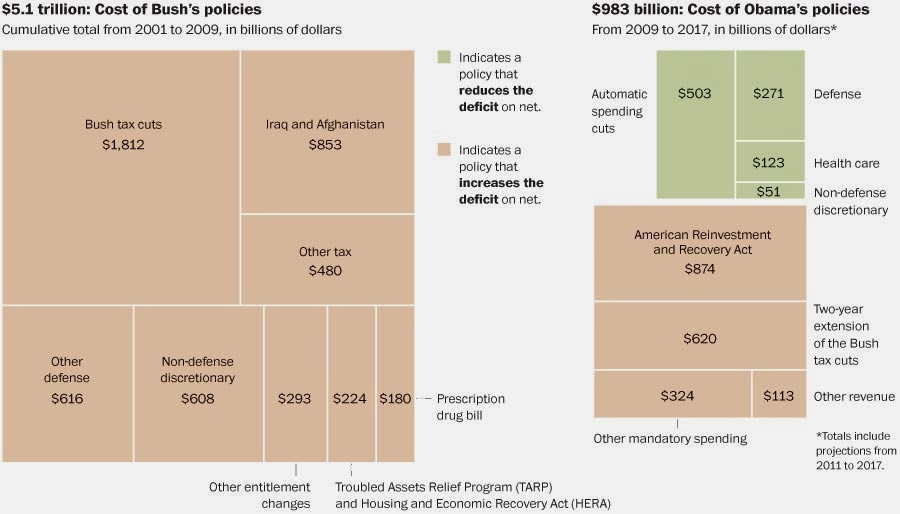
That's why a chart in Monday's New York Times should be sent to every household in the US of A. It shows, in clear, indisputable numbers, that policy decisions by Republican president George W. Bush led to spending that dwarfs financial outlays under Obama. (See the chart at the end of this post.)

In fact, the cost of just the Bush tax cuts ($1.8 trillion) exceeds the costs of all spending under Obama ($1.4 trillion).

The final tally--$5.07 trillion of spending under Bush, $1.44 trillion under Obama. By the way, those figures for Obama are projections from 2009 to 2017. In other words, both presidents are being judged in eight-year time frames. And Bush "wins" the spending contest in a runaway.

If my math is correct, spending under Bush was more than three times greater than that under Obama. Yet we still get bilge like this from the blog of U.S. House Majority Leader Eric Cantor (R-VA): "President Obama Refuses To Acknowledge That His Out Of Control Spending Sparked A Debt Crisis."

In a piece titled "The Chart That Should Accompany All Discussions of the Debt Ceiling," James Fallows of The Atlantic explains why the Times' graphic handiwork is so important:

It's based on data from the Congressional Budget Office and the Center on Budget and Policy Priorities. Its significance is not partisan (who's "to blame" for the deficit) but intellectual. It demonstrates the utter incoherence of being very concerned about a structural federal deficit but ruling out of consideration the policy that was the largest single contributor to that deficit, namely the Bush-era tax cuts.

The chart is titled "Policy Changes Under Two Presidents," and Fallows says it is called that for a reason:

An additional significance of the chart: It identifies policy changes, the things over which Congress and Administration have some control, as opposed to largely external shocks--like the repercussions of the 9/11 attacks or the deep worldwide recession following the 2008 financial crisis. Those external events make a big difference in the deficit, and they are the major reason why deficits have increased faster in absolute terms during Obama's first two years than during the last two under Bush. (In a recession, tax revenues plunge, and government spending goes up--partly because of automatic programs like unemployment insurance, and partly in a deliberate attempt to keep the recession from getting worse.) If you want, you could even put the spending for wars in Iraq and Afghanistan in this category: Those were policy choices, but right or wrong they came in response to an external shock.

The point is that governments can respond to but not control external shocks. That's why we call them "shocks." Governments can control their policies. And the policy that did the most to magnify future deficits is the Bush-era tax cuts. You could argue that the stimulative effect of those cuts is worth it ("deficits don't matter" etc). But you cannot logically argue that we absolutely must reduce deficits, but that we absolutely must also preserve every penny of those tax cuts. Which I believe precisely describes the House Republican position.

In other words, the GOP of 2011 is utterly illogical. But large chunks of the America public still lap up Republican sound bites.
It is dangerous to the economy to make Americans think we're in a debt crisis when we're not. Americans stop spending because they lack confidence in the economy and that lack of spending makes the economy worse. Which is likely the reason Republicans are lying about spending because they want the economy they crashed to crash again under a Democratic president. Conservatives have always put their radical Anti-American agenda before what is best for the nation. So this is nothing new.

Wednesday, June 29, 2011

Republicans Caused The Great Recession. Feeling They Have Not Done Enough Damage They're About to Cause The Great Recession Part Two


Republicans Caused The Great Recession. Feeling They Have Not Done Enough Damage They're About to Cause The Great Recession Part Two

Republicans have been playing a double game with the debt limit debate. On one hand, it’s hard to imagine GOP members of Congress actually blocking a measure that would raise the debt ceiling, because that would lead to sudden, dramatic reductions [1] in government functions: there might not be money for Social Security payments, Medicare checks, military salaries and more. Worse, confidence in US Treasury bills would be seriously wounded if the debt ceiling isn’t raised by August 2, meaning economic catastrophe [2]. Voters would blame Republicans for this economic catastrophe, polls [3] show, and House Speaker John Boehner was warned [4] by Wall Street executives in no uncertain terms that he could not allow this situation to occur.

At the very same time, this nightmare scenario is the only leverage Republicans have in the debt ceiling debate. They’re asking for a whole host of policy changes—from dramatic spending cuts [5] to radical changes [6] to entitlement programs—that would otherwise be non-starters with Democrats in Congress and the White House, but Republicans are refusing to vote for a debt limit increase unless these policy changes are approved. “I must be convinced we have wrung every nickel of spending out of this,” Representative Michael Burgess told [7] World Net Daily.

So far the strategy has worked well for Republicans. Bipartisan talks between the administration and House majority leader Eric Cantor produced tentative agreements to cut $1 trillion [8] from the budget, with Vice President Joe Biden saying [9] he believed the cuts would total as much as $4 trillion. A mandatory and enforceable spending cap may be enacted [10]. Democrats are insisting that tax increases be part of the deal—but only 17 percent [8] of it. The tax increases are targeted to particularly egregious areas, like ending exemptions for private jets or changing rules that allow hedge fund managers to count their income as capital gains, and even though the Bush tax cuts are the number-one [11] driver of the debt, the White House will not insist [12] that a deal that repeals or changes them.

Meanwhile, Obama and Boehner are photographed [13] playing a friendly, back-slapping round of golf. Nothing to see here, folks—the US government is functioning properly.

But over the past week, several GOP actors have upped the ante and painted a very different picture of a government that might not actually be able to solve this problem. And there are potentially serious consequences to this shift.

Not satisfied with having even 17 percent of the debt ceiling deal include tax increases, Cantor and Sen. Jon Kyl walked out [14] of the bipartisan meetings with Biden. Meanwhile, SenatorJim DeMint, who holds powerful sway in the Senate, has said he simply doesn’t believe [15] that the debt ceiling needs to be raised by August 2. This opinion is shared by leaders [16] of national Tea Party organizations and presidential candidate Representative Michele Bachmann [17]. DeMint also says the only acceptable outcome is the passage [18] of a balanced budget amendment, an extreme request that’s almost certain to be left unfulfilled.

This is where the political theatre is getting more dangerous every day. There are serious risks attached to even the appearance that a deal may not happen. As Jared Bernstein explains [19] at his blog, the Treasury Department is currently selling bonds to investors with a relatively low 2.93 percent interest rate. Investors feel comfortable with the low yield because they remain confident that the Treasury bonds are a safe investment. But if that confidence is shaken, investors may demand more, and Bernstein speculates that Treasury might have to add half of a percentage point to the interest rate.

If investors begin to lose confidence in US Treasury bonds like this, there could be serious economic consequences at home, as lending would become even more difficult. At the very least, if the interest rate we’re paying out on Treasury bonds goes up a half-percentage point, that means $50 billion more in annual debt servicing costs—and yes, this would increase the debt and deficit even further.

It’s a bewildering situation. Republicans, who recently voted for a Ryan budget that increases [20] the debt by trillions, are demanding a debt reduction deal that ignores the largest driver of debt—the Bush tax cuts—and the theatrical process they are using to get what they want may itself end up increasing the debt by $50 billion per year.

There may be a deal in the end. But with every passing day of threats and theatrics, the risks get bigger, the debt may get larger, and confidence in the American political system shrinks—with good reason.

[1] http://www.treasury.gov/initiatives/Documents/Debt Limit Myth v Fact FINAL.pdf
[2] http://www.slate.com/id/2291836/
[3] http://old.news.yahoo.com/s/ac/20110624/us_ac/8693841_poll_if_debt_ceiling_compromise_not_reached__blame_republicans_1
[4] http://crooksandliars.com/john-amato/wall-street-tells-boehner-dont-mess-deb
[5] http://www.speaker.gov/News/DocumentSingle.aspx?DocumentID=219059
[6] http://www.huffingtonpost.com/2011/06/19/mitch-mcconnell-debt-ceil_n_879989.html
[7] http://www.thenation.com/blog/160142/economy-hostage-gop-presents-extreme-demands
[8] http://www.washingtonpost.com/blogs/ezra-klein/post/wonkbook-the-debt-ceiling-deal-so-far/2011/06/28/AGdmgxoH_blog.html
Republicans were willing to increase the deficit - shown by two House votes for the Ryan Plan. Now they say they will accept nothing but spending cuts to balance the budget. In other words Republicans are once again showing their deeply anti-American stripes, the kind of fake patriotism Washington warned us about. Unless programs they have always hated such as Medicare, Social Security, education and just about every other program that keeps seniors and children out of bone grinding poverty are gutted- conservatives are willing to blow up the economy one more time. Republicans might be patriots, we just do not know which country they are patriots of.

John Quincy Adams Wikipedia Page Edited by Bachmann Wing-nuts To Describe Him As A ‘Founding Father’