Showing posts with label deficit. Show all posts

Wednesday, September 5, 2012

Romney Myth Busters: Making the Wealthy Even Richer With More Tax Cuts Will Create More Jobs


Romney Myth Busters: Making the Wealthy Even Richer With More Tax Cut Will Create More Jobs

With cunning and contempt and catechismal fervor the super-rich have argued that all money should move to the top, where it will be used to stimulate the economy and create jobs. But they ignore the facts that prove them wrong. And it doesn't take much to prove them wrong.

1. First, a look at the success of the super-rich: Money has quickly moved to the top

Based on IRS figures, the richest 1% nearly tripled its share of America's after-tax income from 1980 to 2006. That's an extra trillion dollars a year. Then, in the first year after the 2008 recession, they took 93% of all the new income.

Wealth is even more skewed. The richest 10% own 83% of financial wealth, which they've skillfully arranged to be taxed at just 15%, ostensibly because they pump that money back into job-creating ventures. More on that misconception later.

Conservatives claim that wealth inequality has remained steady for the richest Americans. But data from Edward Wolff shows that the excess wealth was simply redistributed among the rest of the top 5%, who saw their share of America's net worth increase by 18 percent from 1983 to 2007. It was also noted by Sam Pizzigati that much of the top-level wealth was socked away tax-free overseas, a fact largely confirmed by a Tax Justice Network study.

2. Corporations are just as successful: profits have doubled, taxes cut in half

While corporate profits have doubled to $1.9 trillion in less than ten years, the corporate income tax rate, which for thirty years hovered around the 20-25% level, suddenly dropped to 10% after the recession. The biggest firms basically said "We're not paying."

That's a half-trillion dollars a year unpaid by the very companies who have successfully convinced much of America that their tax rates are too high.

The tax they actually pay is very low relative to other countries. U.S. corporations paid a smaller rate of income taxes than all but two of the OECD countries analyzed by the Office of Management and Budget and the Census Bureau. A Treasury report agreed, noting that the Tax/GDP rate for U.S. companies was 35% lower than the OECD average from 2000 to 2005.

Corporations even pay less than low-wage American workers. On their 2011 profits of $1.97 trillion, corporations paid $181 billion in federal income taxes (9%) and $40 billion in state income taxes (2%), for a total income tax burden of 11%. The poorest 20% of American citizens pay 17.4% in federal, state, and local taxes.

3. Some Non-Job-Creation Facts

The Wall Street Journal noted in 2009 that the Bush tax cuts led to the "worst track record for jobs in recorded history." 25 million people remain unemployed or underemployed, with 30 to 50 percent of recent college graduates in one of those categories. Among unemployed workers, nearly 43 percent have been without a job for six months or longer.

For the jobs that remain, most are low-paying, with the only real employment growth occurring in retail sales and food preparation. A recent report by the National Employment Law Project confirms that lower-wage occupations (up to about $14 per hour) accounted for 21 percent of recession losses and 58 percent of recovery growth, while mid-wage occupations (between $14 and $21 per hour) accounted for 60 percent of recession losses and only 22 percent of recovery growth.

The minimum wage is shamefully low, about 30% lower than the inflation-adjusted 1968 figure. And the tiny pay can't be blamed on small business. Two-thirds of America's low-wage workers, according to another National Employment Law Project report, work for companies that have at least 100 employees.

All these job woes persist while productivity has continued to grow, with an 80% increase since 1973 as median worker pay has stagnated.

4. So what are the "job creators" doing with all their money?

Over 90% of the assets owned by millionaires are held in a combination of low-risk investments (bonds and cash), the stock market, and real estate. Business startup costs made up less than 1% of the investments of high net worth individuals in North America in 2011.

Perhaps, instead, they're building businesses on their own? No. Only 3 percent of the CEOs, upper management, and financial professionals were entrepreneurs in 2005, even though they made up about 60 percent of the richest .1% of Americans. A recent study found that less than 1 percent of all entrepreneurs came from very rich or very poor backgrounds. They come from the middle class.

That deserves repeating. Entrepreneurs come from the middle class.

Not surprisingly, then, since the middle class has been depleted by the steady accumulation of wealth at the top, the number of entrepreneurs per capita has decreased 53% since 1977, and the number of self-employed Americans has decreased 20% since 1991.

5. Big business is even worse at job creation

First of all, the cash holdings for non-financial U.S. firms increased to $1.24 trillion in 2011, with about 57 percent of it stashed overseas. Commerce Department figures show that U.S. companies cut their work forces by 2.9 million from 2000 to 2009 while increasing overseas employment by 2.4 million.

The top holders of cash, including Apple and Google and Intel and Coca Cola and Chevron, are also spending their money on stock buybacks (which increase stock option prices), dividends to investors, and subsidiary acquisitions. According to Bloomberg, share repurchasing is at one of its highest levels in 25 years.

6. The Big Fraud: Tax us less, and the jobs will come

Despite their unwillingness to invest in jobs, and even in the face of damning evidence against their tax myths, the super-rich fight like wildcats at any suggestion that they support the country that provided their wealth. Way back in 1984, right after the Reagan tax cuts, the U.S. Treasury Department came to the obvious but belated conclusion that tax cuts cause a loss of revenue. A 2006 Treasury Department study found that extending the Bush tax cuts would have no beneficial effect on the U.S. economy. Other sources have confirmed that economic growth was fastest in years with relatively high top marginal tax rates.

Ample evidence exists to show that no relationship exists between the capital gains tax rate and investment. As noted in the Washington Post, "The top tax rate on investment income has bounced up and down over the past 80 years - from as high as 39.9 percent in 1977 to just 15 percent today - yet investment just appears to grow with the cycle, seemingly unaffected." In fact, the low rate may even have a negative effect on growth. A Congressional Research Service report states: "Capital gains tax rate increases appear to increase public saving and may have little or no effect on private saving. Consequently, capital gains tax increases likely have a positive overall impact on national saving and investment."

7. So what becomes of the jobs?

Corporations are hoarding over a trillion dollars. The richest 1% take a trillion dollars a year more than productivity-based earnings since 1980. Over eight trillion untaxed dollars is being hidden overseas.

That's a present value of ten trillion misdirected dollars. Just 1/10 of that would create 25 million jobs, one for every unemployed or underemployed worker in America. Or a $45,000 a year job for every college student in the United States.

But the people who call themselves "job creators" do nothing to make that happen.

Yet the Romney-Ryan plan to create jobs - and Republican governors as well - is to further cut taxes. Never mind that we've had ten years of tax cuts not producing jobs. Demand creates jobs. People with jobs who buy cars, toothpaste, cereal and gadgets create jobs, not billionaires who make most of their money from capital gains. It is no coincidence that as we keep the Bush tax cuts and state level conservative politicians cut local taxes, our infrastructure needs needs an upgrade and education spending is down.

Cenk Uygur Unravels Anti-Obama Smiley faced Fascist Wacko Dinesh D’Souza and Conspiracy 2016: Obama’s America

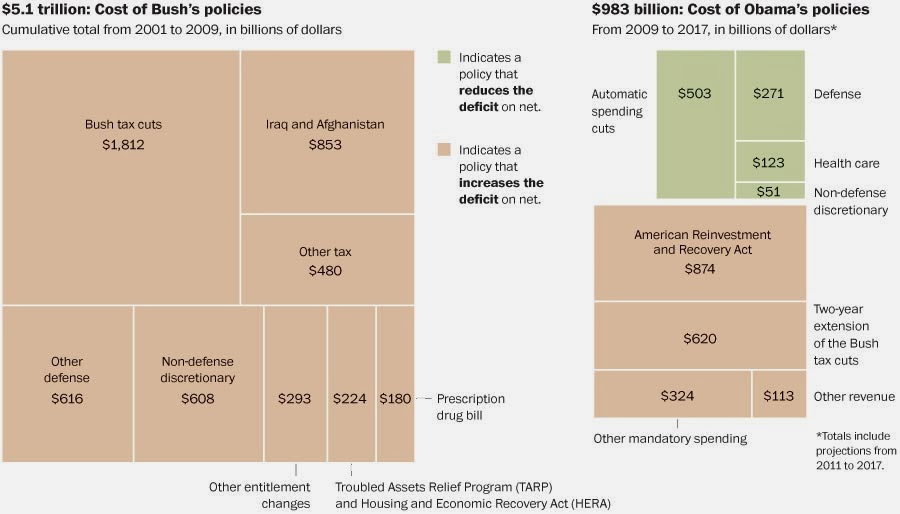
Author Dinesh D’Souza, whose The Roots Of Obama’s Rage is the basis for the newly-released hackumentary 2016: Obama’s America, is making the rounds to promote the film. On Tuesday night’s The Young Turks, host Cenk Uygur confronted D’Souza with the facts behind the film’s deranged view of President Obama, and asked him why he never complained about the George W. Bush policies that exploded the debt, and that President Obama is still paying for.

Dinesh D’Souza could not even bother to look up the correct deficit left by Republicans and Bush in 2008.

Saturday, August 18, 2012

Sleaze Bag of the Week Paul Ryan (R-WI) - His Votes in Congress Added $6.8 Trillion to Our Nation’s Federal Deficits


Sleaze Bag of the Week Paul Ryan (R-WI) - His Votes in Congress Added $6.8 Trillion to Our Nation’s Federal Deficits

The reputation of Rep. Paul Ryan (R-WI) as a fiscal hawk is at odds with his record of supporting nearly every single budget-busting law of the past decade. Since 2001 he has voted for at least 65 separate pieces of deficit- and debt-increasing legislation, with the total tab for all those votes a whopping $6.8 trillion in cumulative deficits.

Rep. Ryan has served as a member of the House of Representatives since 1998. That year the budget was in surplus and stayed that way for the next three years. But with the start of the George W. Bush administration came the return of the red ink. In January 2001, before any Bush administration policies had been passed, the Congressional Budget Office, or CBO, was projecting budget surpluses totaling $5.6 trillion over following decade. Instead, we got cumulative deficits totaling $6.1 trillion, an $11.7 trillion difference. CBO estimates that laws passed by Congress and signed by Presidents Bush and Barack Obama are responsible for $8.5 trillion of that difference. Rep. Ryan cast his vote for about 80 percent of that $8.5 trillion.

Indeed, during the period when the bulk of the deficit-increasing legislation was passed during the Bush administration Rep. Ryan’s record as a fiscal hawk is even more dismal. From 2001 to 2008, Congress passed and President Bush signed legislation that increased the deficit (just in that period) by a cumulative $4 trillion (policies passed during those years added over $6 trillion to the deficits through 2011). Rep. Ryan voted for well over 90 percent of that. (see figure 1).

Those debt-increasing votes began with the first round of Bush tax cuts—estimated at the time to reduce the projected surplus by nearly $1.3 trillion—and continued with every subsequent round of tax cuts. In total, since 2001 Rep. Ryan voted for over $2.5 trillion worth of deficit-financed tax cuts.

Rep. Ryan also voted, repeatedly, to increase federal spending without paying for it. Most notably, he voted in support of every single defense spending bill over the past 11 years. These votes, on both the regular defense appropriations bills and on a series of “emergency supplementals,” have added nearly $1.9 trillion to the deficit since 2001.

Rep. Ryan also voted numerous times to increase nondefense spending. Of course, the most well-known of these votes was on Medicare Part D, which added over $270 billion in unpaid-for spending. But there are many lesser-known examples. In 2002 he voted for an agriculture bill that added $80 billion to the deficit. He voted for changes to military retirement in 2003 that cost $20 billion in added spending. And he voted for increased borrowing authority for flood insurance that increased federal spending by $17 billion.

Rep. Ryan also voted in favor of many of the annual appropriations bills that authorized spending increases for “nondefense discretionary programs.” To be sure, Rep. Ryan occasionally voted against a handful of these, but the net effect of all of his votes was to increase nondefense spending by $1.3 trillion.

All told, Rep. Ryan voted in favor of increasing federal spending by $3.2 trillion—all without offsetting the costs. Combined with his support for $2.4 trillion in tax cuts, Ryan’s votes contributed to adding trillions of dollars to the national debt, which itself led to more spending as the interest payments on that debt grew. Put it all together, and Rep. Ryan voted for over $6.8 trillion worth of cumulative deficits over the past 11 years.

Republicans have always been big spenders. They just never pay for what they put on the tax payer credit card. So the borrowed money has to be paid, plus interests. They know that the general public regularly votes to throw out whoever is in power. That makes it easy to blame Democrats who inherit the crazy irresponsible debt that Republicans leave behind. Republicans cat this way because of the twisted psychology of the right-wing conservative mind. They hate democracy, the had the concept of government by and for the people, so they just do not care how much damage they do to America as long as it benefits the Republican party. Today's icing on the lying hypocrite cake - Paul Ryan denied he sought stimulus fundsQuestioned, he acknowledges his requests. When you get close to Ryan that stink is the thick layer of unwashed hypocrisy.

Friday, June 1, 2012

Sleaze Bag of the Week - Scott Brown (R-MA) is Getting Desperate and Dirty with Sexist Attack On Warren


Sleaze Bag of the Week - Scott Brown (R-MA) is Getting Desperate
and Dirty with Sexist Attack On Warren


In my latest column, “Dems' war FOR women,” I suggested that a power-hungry politics and rightist extremism has led Republicans into attacks on programs vital for women and against pay equity for women. These attacks at times veer into personal campaigns against the women themselves. Witness the many efforts against Hillary Clinton over the years and now, in Massachusetts, witness the slander against Elizabeth Warren by Scott Brown.

In a recent column suggesting that Warren is the great voice of workers, consumers and men and women who are the backbone of the nation I did suggest that Scott Brown was decent. It did not take long for Brown to prove me wrong about that. His dishonest and scandalous attacks against Elizabeth Warren put to shame Brown's argument that he is some sort of "bipartisan" "reasonable man.”

In the end, Scott Brown is just another politician, a handsome and charming guy who will ultimately do anything to win when he fears he could lose.

First Brown implied that Warren was a Harvard elitist. Presumably Brown would attack John F. Kennedy for the same reason. Now Brown suggests that Elizabeth Warren is not really qualified to teach at Harvard. Huh? Brown's using the old Karl Rove-style "dog whistle" attack, suggesting Warren just maybe got the Harvard job because of affirmative action.

What sexist garbage it is that Scott Brown is trying to sell?

Elizabeth Warren got the Harvard job because she was supremely qualified, as are most women who are attacked in this way.

Elizabeth Warren is outstanding by any and all measures at Harvard, admired by her peers and respected by her students.

What is special about Elizabeth is that given her enormous talents she could have sold out like so many others, and made her fortune with any law firm or investment bank, but did not. Instead:

She has fought for women and men who are workers and consumers, fought for economic fairness and financial integrity, fought for lower credit card rates and against banks that charge Mafia-like rates, fought for homeowners against banks that would foreclose upon them (which is why many of those banks hate Warren and support Brown).

If you like the banks, vote for Brown. If you like the consumers, vote for Warren.

Warren has fought in support of active-duty military troops, in support of America's military families, and against those who cheat and abuse our military families and vets (who desperately favor Brown).

Warren has fought for the middle class, for the poor, for the workers and military families and consumers of Massachusetts.

No, Sen. Brown, Elizabeth Warren is not some woman who got a job through affirmative action. She is partially Native American but she has achieved much in life not because of her gender or heritage as you, Sen. Brown, and your great ally, Karl Rove, would suggest, but because of her talent, ability, integrity and hard work.

Elizabeth Warren could have made tens of millions of dollars selling out to greed, as so many of Scott Brown's campaign donors have, but instead, she is one of the most courageous fighters on behalf of workers and consumers and veterans who has ever served in public life in Washington or anywhere else.

Shame on you, Scott Brown.

Thank goodness there are still good people like Elizabeth Warren who are still willing to serve in public life in a system too often dominated by charmers who use dirty politics to support those who cheat the workers and consumers and vets Elizabeth Warren has used her God-given talents fighting for throughout her career.

Many Americans were wondering just who Scott Brown is, he has so many faces it is hard to keep up. Now desperate that he might lose the election to someone who is genuinely concerned with working families, brown has shown his real face. he is a petty pathetic little wing-nut conservative in the pocket of special interests and he cannot compete with a woman of substance and the kind of integrity America needs in Washington. What is Elizabeth Warren's big unforgivable crime? her parents told her she was part Native-American.Conservatives, you know those people who lied us into a 3 trillion dolar war and bankrupted the country wants an election decided on what might be slight exaggerations from someone's parents. Conservatives are once again taking Americans for fools. Let us hope for the future of this great country that this time conservative smears do not work.

11 Ways Mitt Romney Shows He is a Clueless Rich-Guy

The Austerity Agenda is just an excuse to give working class Americans the shaft.

Saturday, May 26, 2012

Republicans Do Not Care About The Deficit. They Care About Cutting The Safety Net for Seniors and Children


Republicans Do Not Care About The Deficit. They Care About Cutting The Safety Net for Seniors and Children

OK, so why does everyone think the deficit is out of control and a threat to the existence of the republic? Good question. It's probably way too late to pull us out of the rabbit hole we've collectively dived into, but anyone reporting on this really owes it to their readers to explain the basic political dynamics at work. So why do Republicans and Democrats both think the deficit is a problem?

    Answer for Republicans: They don't think the deficit is a problem. If they did, they'd favor tax increases, Pentagon cuts, and Medicare cuts, since even the most dimwitted among them knows that cutting domestic discretionary spending won't make a dent in the deficit. But they favor none of these things.

    Rather, they think federal spending on liberal social programs is a problem, and yammering about the deficit is a good way to force cuts to these programs. And there's nothing wrong with this. It's good politics. Why waste a crisis, after all? But anyone reporting on this issue really needs to be honest about what's going on. Republicans want to cut social spending. The deficit is just a handy cudgel to make this happen.

    Answer for Democrats: I'm actually a little stumped here. I think most Democrats understand that the short-term deficit really isn't a problem, and they also understand (I hope) that allowing the Bush tax cuts to expire and letting the economy recover will get us very close to eliminating the primary deficit (i.e., the deficit minus interest payments). If we do that, then publicly held debt as a percent of GDP stabilizes and the deficit problem becomes pretty manageable. The chart on the right from CBPP shows this graphically.

    In the longer term, Medicare growth is a problem — which is just another way of saying that healthcare spending in general is a problem. This needs to be addressed, but it needs to be addressed for its own sake, not just because it affects the federal deficit.

    So why have Democrats joined the deficit chorus? I'm not sure, really. I'd guess it's mainly just fear that they've been outflanked on the issue, and if they want to stay in office they have to yammer about it. But that's just a guess.

In any case, Republicans are wrong: we don't have a spending problem, we have an aging problem. As America ages, Social Security and Medicare are going to cost more, and unless you want to start killing off old people Soylent Green style there's no way to avoid this even if we do get a handle on rising healthcare costs. This in turn means we're going to need more revenue to care for the elderly. As Jon Cohn says today, "It's ridiculous to have a conversation about balancing the budget that won't even contemplate higher taxes."

A perpetually growing deficit will eventually drive up interest rates and slow economic growth, so it's something we should take seriously. But slashing social programs is exactly the opposite of taking it seriously. We need to let the Bush tax cuts expire, get out of Iraq and Afghanistan, keep working hard on reining in healthcare costs, and accept the fact that we're going to need to fund an aging population whether we like it or not. Do that, and all we'll need is modest discipline in the rest of the budget. The long-term deficit is a problem, but it's not a crisis

Perhaps the biggest piece of evidence that conservative Republicans only care about deficits as a political wedge is that they ran up historic deficits from 2001 to 2008 and did not rise one dollar in revenue to pay the deficit down. Mitt Romney has a deficit "reduction" plan, full of accounting gimmicks it will increase the deficit by at at least $3 trillion dollars while cutting the safety net and buying the newest toys for the military.

The Debt Increase Under Obama Is Largely A Result Of Bush-Era Policies

Trump on Romney: ‘He’d Buy Companies, He’d Close Companies, He’d Get Rid Of Jobs’