Showing posts with label conservatism. Show all posts

Wednesday, August 8, 2012

Mitt Romney's Contempt For Morality. Romney's Three Biggest Lies, Just This Week


Mitt Romney's Contempt For Morality. Romney's Three Biggest Lies, Just This Week

“I Have Paid Taxes. Every Year. A Lot of Taxes.”

Romney has been dogged by questions about his tax returns, exacerbated by his steadfast refusal to release more than one year’s worth of taxes. (He’s promised to release one more year in the fall.) Romney faced added scrutiny over the last week, as Senate Majority Leader Harry Reid, D-Nev., has said that a reliable source told him that Romney paid no federal income tax for several years, and that is the reason he won’t release his returns.

Romney and Republicans have demanded that Reid retract the statement, but so far, Romney has been unwilling to release the tax returns that could prove Reid a liar. Instead, Romney chose to go before his supporters and declare that he has too paid taxes — trust him.

“Let me also say categorically: I have paid taxes every year. A lot of taxes. A lot of taxes,” Romney said Friday. That is, of course, almost certainly true. Romney likely paid sales taxes and property taxes and gasoline taxes, just like everyone else. Of course, Romney left a very important word out of his defense: “income.”

Romney was careful not to claim he paid income taxes every year, which are the taxes Reid was talking about. Does that mean Reid is right? Well, without seeing Romney’s tax returns, it’s impossible to say.

One other part of Romney’s statement is a lie: the part where he says he paid “a lot” of taxes. Romney only paid 14 percent of his income in taxes in 2010. That’s because most of his income was investment income, which is taxed at a far lower rate than job income is. Certainly, the dollar amount Romney paid was higher than your average Joe, but the percentage Romney paid is far from burdensome.

...Obama is Going to “Gut Welfare Reform”

For those of you who are either too young to remember the late 20th century (or for those of you who’ve chosen to block it out), welfare reform was once a great Republican bugaboo, the “immigrants are stealing your jobs” of the Reagan era. Ronald Reagan himself once decried the “strapping young bucks” who used welfare to buy “t-bone steaks,” and if that sounds incredibly racist, you’re right.

In 1996, President Bill Clinton helped Republicans achieve their goal of slashing — er, reforming — welfare. The Personal Responsibility and Work Opportunity Act made it harder to get public assistance, especially for women who were seeking post-secondary degrees. While the act did have the effect of kicking a lot of people off of assistance, the initial reports of its significant benefits in reducing poverty were primarily due to the roaring economy of the tech boom.

Why do I mention this? Because Mitt Romney’s base is made up of people who were well into adulthood when the PRWOA was signed into law, people who remember welfare reform as a salient issue. Romney is attempting to appeal to those voters with his second-biggest lie of the week, the lie that President Obama wants to “gut welfare reform.”

Romney’s lie hinges on waivers that the Obama administration is issuing to states that want flexibility to adjust work requirements in the face of the current recession. As the Washington Post’s Ezra Klein wrote last month, “The actual language is rather strict and rules out a number of potential waiver applications.” Job requirements are not going to be eliminated; rather, states will be able to use increased flexibility to help move recipients toward long-term employment.

Given the Republican love of giving the states more power, this may seem like something they would support the president in doing, or at the very least, have trouble arguing against. Romney makes the argument simpler by lying; in the ad, the campaign says, “Under Obama’s plan, you wouldn’t have to work and wouldn’t have to train for a job. They just send you your welfare check and welfare to work goes back to being plain old welfare.”

Incidentally, if you’re wondering where Barack Obama could have gotten the idea of giving states more flexibility on welfare requirements, it may have come from this 2005 letter from the Republican Governor’s Association requesting exactly that from then-Senate Majority Leader Bill Frist. The second signature on the request was then-Massachusetts Gov. Mitt Romney, who was for Obama’s welfare rule changes before he was against them.

....“I’ll work to protect the voting rights of our military, not undermine them.”

Mitt’s biggest lie of the past week is a doozy. Romney claimed that Barack Obama was trying to limit the voting rights of members of the military in Ohio, because of a lawsuit filed in the state over Ohio’s decision to eliminate early voting except for members of the military. Was Obama trying to “undermine” the rights of soldiers? In a word, no. Instead, Obama and the Democratic Party sought to give everyone in Ohio the same rights as Ohio wanted to give soldiers — in other words, to give everyone the opportunity to vote early.

Nevertheless, Romney took to Facebook to play more-patriotic-than-thou, lambasting Obama for “claiming it is unconstitutional for Ohio to allow servicemen and women extended early voting privileges during the state’s early voting period,” something Romney said was an “outrage.” Of course, Obama wants to keep those early voting privileges in place for the military, and extend it for everyone — including veterans. Romney would refuse to give veterans early voting privileges. Who’s undermining voting rights now?

Indeed, Romney’s bald-face lie drew a rejoinder from John Soltz of VoteVets.org, who said, “Obviously with the narrative the Romney campaign is pushing, they probably don’t have a lot of people around them who have actually served. We also agree, like the president does, that someone who served in World World II in the Battle of the Bulge or someone who lost their legs in Vietnam has just as much of a right to vote as today’s veteran.”

With three whoppers in the last week, it’s tempting to ask why Romney thinks he can lie with impunity, but of course, the answer is simple: the media won’t call him on it. Given over to fake even-handedness, the media is stuck saying things like this:

The last president we had who was a serial lying sleaze bag sent off over 4,000 Americans to Iraq to die for a lie. He and his Congressional conservative partners in crime also tanked the economy. Romney has exactly the same arrogant attitude.

Anti-American Fox News and The America Hating Steve Doocy Hides Religious Accommodation For Reproductive Health Mandate 

Fox News' Steve Doocy falsely claimed that the Obama administration was forcing churches to provide contraception coverage to employees, ignoring an exemption that explicitly exempts religious institutions.

On Fox & Friends, Doocy reported on tensions between Catholic Cardinal Timothy Dolan and President Obama due to a Health and Human Services (HHS) rule mandating that all health insurance plans cover women's reproductive health. After religious leaders, including Dolan, protested the move, the Obama administration exempted churches and other religious groups from the mandate.

But Doocy not only ignored the religious accommodations made by the administration on the contraception mandate; he falsely claimed that the mandate still applied to the Catholic Church:

Don't ask me why Fox and Doocy hate America, religious freedom and women's reproductive rights, they just do. Perhaps Steve would be happier in Iran where they believe pretty much the same things Steve and his boss Rupert Murdoch do.

Monday, July 23, 2012

Tis The Season For The Limitless Gutter of Republican Elite Lies


Tis The Season For The Limitless Gutter of Republican Elite Lies

When it comes to the economy, too many Americans continue to be numbed by the soothing sounds of conservative spin in the media. Here are three of their more inventive claims:

1. Higher taxes on the rich will hurt small businesses and discourage job creators

A recent Treasury analysis found that only 2.5% of small businesses would face higher taxes from the expiration of the Bush tax cuts.

As for job creation, it's not coming from the people with money. Over 90% of the assets owned by millionaires are held in a combination of low-risk investments (bonds and cash), the stock market, real estate, and personal business accounts. Angel investing (capital provided by affluent individuals for business start-ups) accounted for less than 1% of the investable assets of high net worth individuals in North America in 2011. The Mendelsohn Affluent Survey agreed that the very rich spend less than two percent of their money on new business startups.

The Wall Street Journal noted, in way of confirmation, that the extra wealth created by the Bush tax cuts led to the "worst track record for jobs in recorded history."

2. Individual initiative is all you need for success.

President Obama was criticized for a speech which included these words: "If you've been successful, you didn't get there on your own...when we succeed, we succeed because of our individual initiative, but also because we do things together."

'Together' is the word that winner-take-all conservatives seem to forget. Even the richest and arguably most successful American, Bill Gates, owes most of his good fortune to the thousands of software and hardware designers who shaped the technological industry over a half-century or more. A careful analysis of his rise shows that he had luck, networking skills, and a timely sense of opportunism, even to the point of taking the work of competitors and adapting it as his own.

Gates was preceded by numerous illustrious Americans who are considered individual innovators when in fact they used their skills to build upon the work of others. On the day that Alexander Graham Bell filed for a patent for his telephone, electrical engineer Elisha Gray was filing an intent to patent a similar device. Both had built upon the work of Antonio Meucci, who didn't have the fee to file for a patent. Thomas Edison's incandescent light bulb was the culmination of almost 40 years of work by other fellow light bulb developers. Samuel Morse, Eli Whitney, the Wright brothers, and even Thomas Edison had, as eloquently stated by Jared Diamond, "capable predecessors...and made their improvements at a time when society was capable of using their product."

If anything, it's harder than ever today to ascend through the ranks on one's own. As summarized in the Pew research report "Pursuing the American Dream," only 4% of those starting out in the bottom quintile make it to the top quintile as adults, "confirming that the 'rags-to-riches' story is more often found in Hollywood than in reality."

3. A booming stock market is good for all of us

The news reports would have us believe that happy days are here again when the stock market goes up. But as the market rises, most Americans are getting a smaller slice of the pie.

In a recent Newsweek article, author Daniel Gross gushed that "The stock market has doubled since March 2009, while corporate profits and exports have surged to records."

But the richest 10% of Americans own over 80% of the stock market. What Mr. Gross referred to as the "democratization of the stock market" is actually, as demonstrated by economist Edward Wolff, a distribution of financial wealth among just the richest 5% of Americans, those earning an average of $500,000 per year.

Thanks in good part to a meager 15% capital gains tax, the richest 400 taxpayers DOUBLED their income and nearly HALVED their tax rates in just seven years (2001-2007). So dramatic is the effect that anyone making more than $34,500 a year in salary and wages is taxed at a higher rate than an individual with millions in capital gains.

There's yet more to the madness. The stock market has grown much faster than the GDP over the past century, which means that this special tax rate is being given to people who already own most of the unearned income that keeps expanding faster than the productiveness of real workers.

And one fading illusion: People in the highest class are people of high class.

Scientific American and Psychological Science have both reported that wealthier people are more focused on self, and have less empathy for people unlike themselves.

This sense of self-interest, according to a study published in the Proceedings of the National Academy of Sciences and other sources, promotes wrongdoing and unethical behavior.

Can't help but think about bankers and hedge fund managers.

Paul Buchheit is the founder and developer of social justice and educational websites (UsAgainstGreed.org, PayUpNow.org, RappingHistory.org)

In another age a moderate conservative ( remember them) called this phenomenon voodoo economics - where you redistribute the capital produced by American labor to the top of the pyramid. Why? Well there are many reason people buy into this. One is that low to modest income conservative Republicans are obsessed with someone getting $4 in food assistance they fell they don't deserve, but do not care about the plutocrats at the top taking most of the value produced by the work they do. Working class Republicans are happy to make their plantation masters happy as long as those people over there - the nebulous other - does not get a few pennies in assistance during tough times. Tough times created by the plutocrats they vote into power. A great example of people not acting in their own rational self interests.

Conservative Evangelical Leaders Blame Liberals, Media For Aurora Shootings, Say Only Christian Victims Will Go To Heaven

Democrats Crush Republicans as Capitalists in the White House

I think its great that CNN has an affirmative action program for the brain dead, Erick Erickson Brings Fox's Bogus Small-Business Attack On Obama To CNN. And I thought Erick was going to lead the American Dish Detergent Revolution.

Saturday, July 21, 2012

Mitt Romney Is A Capitalist The Way A Bank Robber Is A Champion Of The Free Market


Mitt Romney Is A Capitalist The Way A Bank Robber Is A Champion Of The Free Market

A splendid accidental benefit of this year’s Republican presidential primary is that one of the most abusive dark corners of American capitalism, so-called private equity, is coming in for belated scrutiny and scorn. Delectably, the disclosures and criticisms are coming from leading Republicans, in a blatant undermining of cherished Republican ideology. Even before Democrats lay a glove on Romney, he will be assaulted by an investigative documentary that is more Michael Moore than Adam Smith. In politics, it doesn’t get much better than this.

“Private equity” was rebranded in the 1990s. It used to be called, more honestly, leveraged buyouts. While the job-killing aspect of many of the deals done by Mitt Romney’s Bain Capital and kindred financial engineers has come in for withering criticism, that is only one part of the mischief.

The phrase “private equity” conjures up images of venture capitalists pooling their funds and backing promising new ventures or contributing new equity and new management to companies in need of restructuring. But that is not how the game really works most of the time. Typically, private-equity companies borrow a ton of money, sometimes in collusion with incumbent management and sometimes in opposition to it, and take a company private. That is, the company’s shares are no longer publicly traded.

This maneuver has several advantages to the new owners. First, despite the picture of investors putting in equity, most of the money is usually borrowed. That produces a huge tax break, since the interest is tax-deductible. Second, the new owners can pay themselves large management fees as well as “special dividends.” Typically, they take out far more than they put in, by incurring debts carried on the books of the operating company.

For instance, when Bain masterminded a private-equity deal for HCA, one of America’s largest for-profit hospital chains (which has gone from private to public twice and which paid a multibillion-dollar fine for defrauding Medicare), Bain paid itself a management fee of $58 million, even though it had only put up 6.3 percent of the buyout fund.

Another big plus: The main regulatory principle protecting investors and by extension, the system as a whole, is disclosure. Under the securities laws administered by the Securities and Exchange Commission, management must disclose information deemed “material” to the interests of the investing public, including salaries, earnings, losses, assets, liabilities, and risks. But these laws flow from the fact that a corporation’s shares are publicly traded. A company owner by a private-equity outfit like Bain can operate completely in the shadows.

Then, there are three possible ways to cash in.  If the company turns out to be a success, like Staples (one of Bain’s big winners), the private-equity owners can take their legitimate share of the reward. But that turns out to be the exception. If the company, newly loaded up with debt, starts to falter, it can be broken up, with massive layoffs and cuts in health and pension benefits, and resold, usually at a profit for the private-equity owners.

Or the company can simply declare bankruptcy under Chapter 11 and shed its debts. Normally, shareholders think twice about incurring risks that could result in  bankruptcy, because one of the consequences is that the stock becomes worthless. But private-equity owners typically have already made their bundle on management fees and special dividend payouts, so even if the operating company goes bankrupt, they are still in the money.

And all of this is legal.

Oddly, as one abuse after another was exposed following the financial collapse, the predations of private equity have sailed merrily on. There is a terrific 2009 book on the subject, which I reviewed for the Prospect, Josh Kosman’s The Buyout of America. Read Kosman, and you will learn chapter and verse about how Bain, Carlyle, Blackstone, Texas Pacific Group, and the others plunder operating companies with taxpayer subsidies thanks to the borrowed money.

Among the tales Kosman tells: Thomas H. Lee Partners buys Warner Music, the world's fourth-biggest music company, and loads up the company with debt to finance the buyout and to pay itself $1.2 billion in dividends. One-third of the workforce is fired. CD&R, The Carlyle Group, and Merrill Lynch buy Hertz, the nation's largest auto-rental company, putting up just $2.3 billion in cash out of a $15 billion deal. The private-equity owners quickly recoup more than half of their down payment by loading up the company with even more debt. Funds for rental operations are cut by 39 percent, and Hertz's market share falls. In another example, Bain Capital, the company that made Mitt Romney rich, invests just $18.5 million in KB Toys, extracts $85 million in dividends, then takes the company into bankruptcy, stiffing employees, investors, and creditors.

In their tactical attack on Mitt Romney, the other Republicans have painted themselves into a corner. They owe it to the public to explain just what is improper about what private-equity operators do, what should be illegal, and what should be subject to disclosure.

Many Americans, bless them, have some naive ideas about how modern capitalism works in the USA. Many, if not most think if you work hard you earn money. You might get promotions and rises based on merit. You get ahead mostly by playing fair and being a decent human being. That is pretty much the way things operate for most Americans. Romney, Bain, Carlye group, and Blackstone operate by different rules. They make money as parasites on the value or capital created by others. That is not capitalism or even Americanism, it is moral corruption of the worse kind. No nation in history that has fallen so deep into this kind of depraved behavior has survived unscathed. We are well on our way to be a nation not of and for the people, but of and for the upper 1%. They used to call that tyranny.

CNN Facilitates Romney's Deceptive Highly Edited Video Attack Ad Against Obama and

Romney To Release Misleadingly Edited Obama Video As An Ad

Elizabeth Warren, a Democratic nominee for Senate in Massachusetts, has said that the Libor scandal calls the integrity of the entire financial system into question. Her opponent the morally bereft Scott Brown doesn't care because without a corrupt system where are his contributions going to come from.


Thursday, July 19, 2012

Republican Lies About Spending and Deficits Exposed


Republican Lies About Spending and Deficits Exposed

We’re at the edge of the cliff of deficit disaster!  National security spending is being, or will soon be, slashed to the bone!  Obamacare will sink the ship of state!

Each of these claims has grabbed national attention in a big way, sucking up years’ worth of precious airtime. That’s a serious bummer, since each of them is a spending myth of the first order. Let’s pop them, one by one, and move on to the truly urgent business of a nation that is indeed on the edge.

Spending Myth 1:  Today’s deficits have taken us to a historically unprecedented, economically catastrophic place.

This myth has had the effect of binding the hands of elected officials and policymakers at every level of government.  It has also emboldened those who claim that we must cut government spending as quickly, as radically, as deeply as possible.

In fact, we’ve been here before.  In 2009, the federal budget deficit was a whopping 10.1% of the American economy and back in 1943, in the midst of World War II, it was three times that -- 30.3%. This fiscal year the deficit will total around 7.6%. Yes, that is big. But in the Congressional Budget Office’s grimmest projections, that figure will fall to 6.3% next year, and 5.8% in fiscal 2014. In 1983, under President Reagan, the deficit hit 6% of the economy, and by 1998, that had turned into a surplus. So, while projected deficits remain large, they’re neither historically unprecedented, nor insurmountable.

More important still, the size of the deficit is no sign that lawmakers should make immediate deep cuts in spending. In fact, history tells us that such reductions are guaranteed to harm, if not cripple, an economy still teetering at the edge of recession.

A number of leading economists are now busy explaining why the deficit this year actually ought to be a lot larger, not smaller; why there should be more government spending, including aid to state and local governments, which would create new jobs and prevent layoffs in areas like education and law enforcement. Such efforts, working in tandem with slow but positive job growth in the private sector, might indeed mean genuine recovery. Government budget cuts, on the other hand, offset private-sector gains with the huge and depressing effect of public-sector layoffs, and have damaging ripple effects on the rest of the economy as well.

When the economy is healthier, a host of promising options are at hand for lawmakers who want to narrow the gap between spending and tax revenue. For example, loopholes and deductions in the tax code that hand enormous subsidies to wealthy Americans and corporations will cost the Treasury around $1.3 trillion in lost revenue this year alone -- more, that is, than the entire budget deficit. Closing some of them would make great strides toward significant deficit reductions.

Alarmingly, the deficit-reduction fever that’s resulted from this first spending myth has led many Americans to throw their support behind de-investment in domestic priorities like education, research, and infrastructure -- cuts that threaten to undo generations of progress. This is in part the result of myth number two.

Spending Myth 2: Military and other national security spending have already taken their lumps and future budget-cutting efforts will have to take aim at domestic programs instead.

The very idea that military spending has already been deeply cut in service to deficit reduction is not only false, but in the realm of fantasy.

 There are a few other details at the link, including the ridiculous Republican urban myth that Obamacare will increase the deficit ( that is utterly false), that government health care (Medicare) is too expensive and we should privatize it Medicare is more cost effective than private insurance). Why do Republicans use these myths as a crutch; because they cannot win the battle on ideas based on facts. Conservative constantly engage in the sleaze of fake patriotism - hiding their freakish agenda behind the flag, and behind the Bible. They should be ashamed, but they seem to lack the moral conscience to feel shame.

Conservative Republicans are actively trying to stop job creation. Not exactly how a patriot should act.

Conservative Republican Journalist and Pervert James O'Keefe Fails To Find A Scandal, Union And Public Works Edition

Saturday, July 7, 2012

Don't Have a Job? Say Thanks to Conservative Republicans


Don't Have a Job? Say Thanks to Conservative Republicans

New numbers released today by the Bureau of Labor Statistics show that the economy added a mere 80,000 jobs in June. That’s down from an average of 150,000 jobs a month for the first part of the year, and far too little to keep up with population growth.

Republican intransigence on economic policy has been a key contributor to the sluggish recovery. As early as 2009, Republican fear-mongering over spending and their readiness to filibuster in the Senate helped convince the White House economic team that an $800 billion stimulus was the most they could hope to get through Congress. Reporting has since revealed that the team thought the country actually needed a stimulus on the order of $1.2 to $1.8 trillion. The economy’s path over the next three years proved them right. Here are the top five ways the Republicans have sabotaged the economic recovery since:

    1. Filibustering the American Jobs Act. Last October, Senate Republicans killed a jobs bill proposed by President Obama that would have pumped $447 billion into the economy. Multiple economic analysts predicted the bill would add around two million jobs and hailed it as defense against a double-dip recession. The Congressional Budget Office also scored it as a net deficit reducer over ten years, and the American public supported the bill.

    2. Stonewalling monetary stimulus. The Federal Reserve can do enormous good for a depressed economy through more aggressive monetary stimulus, and by tolerating a temporarily higher level of inflation. But with everything from Ron Paul’s anti-inflationary crusade to Rick Perry threatening to lynch Chairman Ben Bernanke, Republicans have browbeaten the Fed into not going down this path. Most damagingly, the GOP repeatedly held up President Obama’s nominations to the Federal Reserve Board during the critical months of the recession, leaving the board without the institutional clout it needed to help the economy.

    3. Threatening a debt default. Even though the country didn’t actually hit its debt ceiling last summer, the Republican threat to default on the United States’ outstanding obligations was sufficient to spook financial markets and do real damage to the economy.

    4. Cutting discretionary spending in the debt ceiling deal. The deal the GOP extracted as the price for avoiding default imposed around $900 billion in cuts over ten years. It included $30.5 billion in discretionary cuts in 2012 alone, costing the country 0.3 percent in economic growth and 323,000 jobs, according to estimates from the Economic Policy Institute. Starting in 2013, the deal will trigger another $1.2 trillion in cuts over ten years.

    5. Cutting discretionary spending in the budget deal. While not as cataclysmic as the debt ceiling brinksmanship, Republicans also threatened a shutdown of the government in early 2011 if cuts were not made to that year’s budget. The deal they struck with the White House cut $38 billion from food stamps, health, education, law enforcement, and low-income programs among others, while sparing defense almost entirely.

There have also been a few near-misses, in which the GOP almost prevented help from coming to the economy. The Republicans in the House delayed a transportation bill that saved as many as 1.9 million jobs. House Committees run by the GOP have passed proposals aimed at cutting billions from food stamps, and the party has repeatedly threatened to kill extensions of unemployment insurance and cuts to the payroll tax.

According to the Congressional Budget Office, those policies — the payroll tax cut, food stamps, unemployment insurance, and discretionary spending for low-income Americans — have the highest multipliers, meaning more job boosting potential per dollar.

Since the tea baggers voted in a majority in the House of Representatives in 2010 and Republicans in the Senate - even though they are the minority - have used the filibuster or threats of one to kill any jobs bills, there is not much Obama can do. In a round about way Mitt Romney agrees. H/T to here for this video,
Gov. Romney on Poor Job Growth in Massachusetts: ‘To Suggest That Somehow the Day I Got Elected, Jobs Should Have Immediately Turned Around, Well, That Would Be Silly’
[When] Romney himself was running a government, in his case the state of Massachusetts, he was even more defensive about his lack of control of the employment picture than Obama is today. A new video unearthed by the liberal research group American Bridge shows Romney at a press conference in June 2006 admonishing reporters on disappointing jobs data. “You guys are bright enough to look at the numbers. I came in and the jobs had been just falling right off a cliff, I came in and they kept falling for 11 months,” he explains.

    “And if you are going to suggest to me that somehow the day I got elected, somehow jobs should have immediately turned around, well that would be silly. It takes awhile to get things turned around. We were in a recession, we were losing jobs every month,” he added.

USA Today's Uninformed Campaign To Shame The Poor - A USA Today editorial is downplaying poverty and food insecurity in America, and using Fox News talking points to justify a push to cut vital and effective anti-poverty programs.

Tuesday, June 19, 2012

Republican Weenie of the Day, Scott Brown (R-MA)


Republican Weenie of the Day, Scott Brown (R-MA)

Senator Scott Brown said he will accept a debate at the ­Edward M. Kennedy Institute but only on the condition that Vicki Kennedy stay neutral in the election and that MSNBC not be included as a broadcast partner.

The Brown campaign said in a press release that it would agree to allow former NBC ­anchor Tom Brokaw to moderate.

Elizabeth Warren has already accepted the Sept. 27 debate, but Brown had previously not committed. The candidates are jointly committed to two other televised debates so far, one in the Boston market and a second one in Western Massachusetts.

....Brown has agreed to two ­radio debates, including one moderated by Dan Rea, a conservative-leaning talk show host, and another hosted by Margery Eagan, a Boston Herald columnist, and Jim Braude, a Democrat and former Cambridge city councilor.

Brown is a afraid that at some point he will have to honestly answer some tough questions, instead of being tossed fuzz balls by spineless conservative puppets like Dan Rea. Once again brown is inadvertently sending the public a message about his character and courage - he admits he is a weenie, that he has plenty to hide and has no respect for the democratic process.

Saturday, June 9, 2012

Mitt Romney's Pants Are on Fire. Does America Want a Sleazy Serial Liar As President


Mitt Romney's Pants Are on Fire. Does America Want a Sleazy Serial Liar As President

Yesterday, Mitt Romney gave a big speech in which he accused Obama of lighting a “prairie fire of debt.” It’s a good line, and it has received widespread media coverage.

Romney’s speech has already been dissected by Jonathan Chait and Steve Benen. They note that it’s entirely at odds with conventional understanding of how deficits work, and utterly disconnected from context, rendering it almost unquantifiably misleading.

But I wanted to make another point. If you scan through all the media attention Romney’s speech received, you are hard-pressed to find any news accounts that tell readers the following rather relevant points:

1) Nonpartisan experts believe Romney’s plans would increase the deficit far more than Obama’s would.

2) George W. Bush’s policies arguably are more responsible for increasing the deficit than Obama's are.

Oh, sure, many of the news accounts contain the Obama campaign’s response to Romney’s speech; the Obama campaign put out a widely-reprinted statement arguing that Romney’s plans would increase the deficit and that he’d return to policies that created it in the first place.

But this shouldn’t be a matter of partisan opinion. On the first point, independent experts think an actual set of facts exists that can be used to determine what the impact of Romney’s policies on the deficit would be. And according to those experts, based on what we know now, Romney’s policies would explode the deficit far more than Obama’s would.

The nonpartisan Tax Policy Center has taken a close look at this question. It has determined that relative to current policy — that is, if you keep the Bush tax cuts in place, as Romney wants to do — Romney’s tax cutting plans would increase the deficit by nearly $5 trillion over 10 years. That’s on top of keeping the Bush tax cuts for the rich. Romney has promised to close various loopholes to pay for his tax cuts, but he hasn’t specified which ones. Until he does, the Tax Policy Center concludes, his plan would cost $5 trillion — which would be added, yes, to the deficit.

By contrast, Obama’s plans would not increase the deficit by anything close to that amount. Relative to current policy, the Tax Policy Center has found, Obama’s plan would reduce the deficit by approximately $2 trillion over the next decade. Now, under Obama, the deficit would still increase. That’s because current policy means we’re forgoing the $4.5 trillion in revenues we’d gain if we let all the Bush tax cuts expire. But neither candidate is going to do that. Obama, however, would end the Bush tax cuts for the rich and bring in revenues through a variety of other tax increases. Bottom line: relative to current policy, Obama’s plan would reduce the deficit by bringing in $180 billion or more in revenues a year, or approximately $2 trillion over 10 years; Romeny’s plan would increase the deficit by nearly $500 billion a year — $5 trillion over ten years.

The Tax Policy Center’s Roberton Williams summed it up perfectly in a quote to me:

    “The bottom line is that whatever baseline you use, until Romney makes good on his promise to pay for his tax cuts, he would increase the deficit far more than Obama would.”

On the second point, the Center on Budget and Policy Priorities has determined that the policies put in place under Bush are the main driver of the deficits that are projected over the next decade.

Yet anti-American PACs like American Crossroads are running ads complaining about the deficit. They support a Romney presidency and the Romney/Paul Ryan (R-WI) economic plan which will increase the deficit and mean severe cuts to Medicare and Medicaid. Obama's debt bad, conservative Republican debt is good. Its the Bush 43 presidency redux. Tell the Big Lie and repeat constantly.

Another thing the current pro-Romney ads are claiming is that Romney is a job creator. We have been through this round of lies already and the Romney as job creator myth will continue. Only the numbers will never add up. If Romney practiced accounting the way he figures his jobs record he would be arrested for fraud, but since he is a conservative he gets away with pants on fire lies. The ads are only using the jobs that some companies added, but they do not count the number of jobs lost. In a rare moment of candor - Romney Camp Admits That Its Bain Job Creation Number Is Bogus

Mitt Romney, last night’s Iowa caucus winner, has been on the campaign trail claiming that the private equity firm he ran, known as Bain Capital, was responsible for creating loads of jobs. Romney responded to criticism about his time at Bain by saying, “I’m very happy in my former life; we helped create over 100,000 new jobs.”

When a group of Romney backers ran an ad making the same claim, they were unable to back up the number with data. And as it turns out, the Romney camp can’t either, as it admitted that the statistic is nothing but cherry-picked job growth from a few companies that did well after they were bought by Bain:

    [Romney spokesman Eric] Fehrnstrom says the 100,000 figure stems from the growth in jobs from three companies that Romney helped to start or grow while at Bain Capital: Staples (a gain of 89,000 jobs), The Sports Authority (15,000 jobs), and Domino’s (7,900 jobs).

    This tally obviously does not include job losses from other companies with which Bain Capital was involved — and are based on current employment figures, not the period when Romney worked at Bain. (Indeed, Romney made his comments in response to a former employee of American Pad & Paper Co. who says he lost his job after Bain Capital took it private.)

Bain Capital has been responsible for thousands of layoffs at companies it bankrupted, such as American Pad & Paper, Dade International, and LIVE Entertainment, which Romney’s stat completely leaves out. He’s also taking credit for jobs created long after he left the firm to launch his political career. To sum it up, the stat Romney uses is incredibly dishonest, like much of his jobs rhetoric.

Only in conservative LalaLand could Romney be thought of as a "success". When the rich rob the middle-class to make money that is a kind of theft, not success.

Tuesday, June 5, 2012

Conservative Republicans Want to Rise Taxes for Low Income Americans and Lower Taxes Again for Millionaires


Conservative Republicans Want to Rise Taxes for Low Income Americans and Lower Taxes Again for Millionaires

An oft-repeated Republican talking point is that close to half of all federal income tax filers have no tax liability. Prominent Republicans often imply that these people ought to be paying federal income taxes — and that they don’t is a major cause of the budget deficit.

Last year, Senator Orrin Hatch of Utah, the ranking Republican on the tax-writing Senate Finance Committee, declared that taxes on the rich should not be raised until the poor are taxed. “I think many taxpayers are skeptical that the answer to our fiscal problems is for them to sacrifice more, when almost half of all households are not paying any income taxes,” Mr. Hatch said.

In April, Representative Eric Cantor of Virginia, the House majority leader, said it was “unfair” that 45 percent of people don’t pay any federal income taxes. Asked if he wanted to increase taxes on these people, he replied, “You’ve got to discuss that issue.”

In May, Richard Mourdock, the Republican Senate nominee in Indiana, likened the current split between taxpayers and nontaxpayers to the pre-Civil War division of the nation between slave and free. Consciously using Abraham Lincoln’s famous “house divided” terminology from 1858, Mr. Mourdock said, “When 47 percent are paying no income taxes — they do pay Social Security, but they are not paying income taxes — and 53 percent are carrying the load, we are a house divided.”

In a McClatchy-Marist College poll in early November, 71 percent of Republicans said they believed the poor should not be exempt from income taxes and only 26 percent said they thought the poor should not have to pay them.

This is ironic, because two of the measures most responsible for the rise in the number of nontaxpayers are the earned income tax credit and the child credit — both Republican initiatives. Together they account for 30 percent of the nontaxpaying population, according to the Tax Policy Center.

Once upon a time, Republicans were more concerned about the number of rich people with no income tax liability.

On Jan. 17, 1969, just days before Richard Nixon’s inauguration, the departing treasury secretary, Joseph Barr, disclosed that in 1967, 155 Americans with an income of more than $200,000 had no income tax liability, including 21 with an income above $1 million.

This was considered such a scandal that Nixon sent a tax package drafted by the Johnson administration to Congress with his endorsement. When the Tax Reform Act of 1969 was enacted, including a minimum tax to force rich people to pay something, he praised that provision.

As Nixon said in his signing statement:

    A large number of high-income persons who have paid little or no federal income taxes will now bear a fairer share of the tax burden through enactment of a minimum income tax comparable to the proposal that I submitted to the Congress, which closes the loopholes that permitted much of this tax avoidance.

Ronald Reagan defended his tax reform proposal on the grounds that it would reduce the number of nontaxpaying rich people. In a June 6, 1985, speech, he said:

    We’re going to close the unproductive tax loopholes that have allowed some of the truly wealthy to avoid paying their fair share. In theory, some of those loopholes were understandable, but in practice they sometimes made it possible for millionaires to pay nothing, while a bus driver was paying 10 percent of his salary, and that’s crazy. It’s time we stopped it.

Among the specific measures Reagan supported to increase tax fairness was an increase in the tax on capital gains to 28 percent from 20 percent.

From Bruce Bartlett held senior policy roles in the Reagan and George H.W. Bush administrations and served on the staffs of Representatives Jack Kemp and Ron Paul. Bartlest is partially wrong on one point - the earned income credit - mostly aimed at low income families - was a bi-partisan effort. remember when every once in a while Washington would do something good and bi-partisan. Conservatism has become a joke. It ran up massive deficits and as Dick Cheney explained - "deficits don't matter". Then that Democratic guy became president and suddenly deficits became urgent. Only conservative busted the economy - not a good time to focus on deficits. A time when sane people would focus on rising revenue from the people that can most afford it - the very wealthy.

The knuckle draggers at Breitbarf are trying to recycle the Bill Ayers meme against Obama. Not able to find any actual damning evidence they just make things up - because having all the integrity of a cockroach is a conservative value - #Breitbart.com Bombshell Exclusive: Professor Did Not See Barack Obama at Bill Ayers’ House!


Wednesday, May 30, 2012

Why Does Mitt Romney Hate Retired Americans and the Disabled


What Does Mitt Romney Hate Retired Americans and the Disabled

Mitt Romney’s proposals to cap total federal spending, boost defense spending, cut taxes, and balance the budget would require extraordinarily large cuts in other programs, both entitlements and discretionary programs, according to our revised analysis based on new information and updated projections.

For the most part, Governor Romney has not outlined cuts in specific programs. But if policymakers exempted Social Security from the cuts, as Romney has suggested, and cut Medicare, Medicaid, and all other entitlement and discretionary programs by the same percentage — to meet Romney’s spending cap, defense spending target, and balanced budget requirement — then non-defense programs other than Social Security would have to be cut 29 percent in 2016 and 59 percent in 2022 (see Figure 1). Without the balanced budget requirement, the cuts would be smaller but still massive, reaching 40 percent in 2022.

The cuts that would be required under the Romney budget proposals in programs such as veterans’ disability compensation, Supplemental Security Income (SSI) for poor elderly and disabled individuals, SNAP (formerly food stamps), and child nutrition programs would move millions of households below the poverty line or drive them deeper into poverty. The cuts in Medicare and Medicaid would make health insurance unaffordable (or unavailable) to tens of millions of people. The cuts in non-defense discretionary programs — a spending category that covers a wide variety of public services such as elementary and secondary education, law enforcement, veterans’ health care, environmental protection, and biomedical research — would come on top of the deep cuts in this part of the budget that are already in law due to the discretionary funding caps established in last year’s Budget Control Act (BCA).
Box 1: The Romney Tax Cuts and Our Estimates

Governor Romney has said he would offset an unspecified portion of his proposed tax cuts by reducing tax exemptions, deductions, and other preferences known as “tax expenditures.” Because of Romney’s spending cap (which covers interest payments along with other spending) and his balanced budget requirement, the depth of his required budget cuts depends on the degree to which the cost of his tax cuts would be offset through reductions in tax expenditures. In this analysis, we assume that Governor Romney would offset half of his proposed tax cuts, though we also provide estimates under alternate assumptions. This is a generous assumption: estimates from the Urban Institute-Brookings Tax Policy Center indicate that the Romney tax cuts would cost about $4.9 trillion over ten years. Securing tax-expenditure savings equal to half that amount — about $2.4 trillion — would be extremely difficult, especially since Governor Romney has said he would not increase the low tax rate on capital gains and dividend income and would not cut heavily into tax expenditures for the middle class. Analysts at the Congressional Research Service recently concluded that securing savings of more than $100 or $150 billion a year from tax expenditures is likely to be difficult to achieve.

As explained below, our estimates of the depth of spending cuts that the Romney proposals would require are broadly consistent with what Governor Romney himself has said about the magnitude of his spending reductions. These updated estimates are based on new information and proposals from the governor, updated budget and economic projections from the Congressional Budget Office (CBO), modifications in our own assumptions about “current policy” to match those that CBO and other budget analysts use, and other relevant factors.

Governor Romney’s cuts would be substantially deeper than those required under the austere House-passed budget plan authored by Budget Committee Chairman Paul Ryan (R-WI). Over the 2014-2022 period, Romney would require cuts in programs other than Social Security and defense of $7 trillion to $10 trillion, compared with a little over $5 trillion under the Ryan budget. By 2022, Romney’s cuts would shrink non-defense discretionary spending — which, over the past 50 years, has averaged 3.9 percent of gross domestic product (GDP) and has not fallen below 3.2 percent — to between 1.1 percent and 1.6 percent of GDP.
The Romney Budget Proposals

During his campaign, Governor Romney has made four proposals that would significantly affect the overall level of federal spending, taxes, and the deficit:

    Cap total spending:  "Reduce federal spending to 20 percent of GDP by the end of my first term" and "cap it at that level."[1]
    Increase defense spending:  "Set a core defense spending floor of 4 percent of GDP."[2]   "Core defense spending," as Governor Romney defines it, encompasses 93 percent of the national defense budget function.
    Cut taxes:  Continue current tax policy by permanently extending the 2001 and 2003 tax cuts and other tax cuts that are scheduled to expire, further reduce income tax rates by another 20 percent (the top tax rate thus would be 28 percent), eliminate the estate tax, eliminate the taxation of investment tax for people other than those with high incomes, reduce the corporate income tax, and repeal the taxes enacted in the 2010 health reform legislation.[3] 
    Balance the budget:  "I am planning on getting a balanced budget."[4]

This paper examines the combined effect of these four proposals, since they interact, to determine the amount of spending that would be available for programs other than core defense.

because it has been generally such a well run program Medicare costs have risen much slower and lower than private insurance costs. Mitt Romney's plans would accelerate medicare costs to exceed those of private insurance - imagine seniors having to pay 29% to 59% more out of their pocket.

Time for the Department of Justice to Investigate Criminal and Currently Gov of Florida Rick Scott For Purging Eligible Voters From Florida’s Rolls

Mitt Romney Embraces the flip-flop to pander to extreme conservative voters, Romney Campaign Attacks Stimulus Mitt Once Supported

Monday, May 28, 2012

Memorial Day Thoughts on National Defense Spending and Priorities


Memorial Day Thoughts on National Defense Spending and Priorities

We can best honor those who have given their lives for this nation in combat by making sure our military might is proportional to what America needs.

The United States spends more on our military than do China, Russia, Britain, France, Japan, and Germany put together.

With the withdrawal of troops from Afghanistan, the cost of fighting wars is projected to drop – but the “base” defense budget (the annual cost of paying troops and buying planes, ships, and tanks – not including the costs of actually fighting wars) is scheduled to rise. The base budget is already about 25 percent higher than it was a decade ago, adjusted for inflation.

At a time when Medicare, Medicaid, and non-defense discretionary spending (including most programs for the poor, as well as infrastructure and basic R&D) are in serious jeopardy, Obama and the Democrats should be calling for even more defense cuts.

One big reason: It’s almost impossible to terminate large defense contracts. Defense contractors have cultivated sponsors on Capitol Hill and located their plants and facilities in politically important congressional districts. Lockheed Martin, Raytheon, and others have made spending on national defense into America’s biggest jobs program.

So we keep spending billions on Cold War weapons systems like nuclear attack submarines, aircraft carriers, and manned combat fighters that pump up the bottom lines of defense contractors but have nothing to do with 21st-century combat.

For example, the Pentagon says it wants to buy fewer F-35 joint strike fighter planes than had been planned – the single-engine fighter has been plagued by cost overruns and technical glitches – but the contractors and their friends on Capitol Hill promise a fight.

The absence of a budget deal on Capitol Hill is supposed to trigger an automatic across-the-board ten-year cut in the defense budget of nearly $500 billion, starting January.

But Republicans have vowed to restore the cuts. The House Republican budget cuts everything else — yet brings defense spending back up. Mitt Romney’s proposed budget does the same.

Yet even if the scheduled cuts occur, the Pentagon is still projected to spend over $2.7 trillion over the next ten years.

At the very least, hundreds of billions could be saved without jeopardizing the nation’s security by ending weapons systems designed for an age of conventional warfare. We should shrink the F-35 fleet of stealth fighters. Cut the number of deployed strategic nuclear weapons, ballistic missile submarines and intercontinental ballistic missiles. And take a cleaver to the Navy and Air Force budgets. (Most of the action is with the Army, Marines and Special Forces.)

At a time when Medicare, Medicaid, and non-defense discretionary spending (including most programs for the poor, as well as infrastructure and basic R&D) are in serious jeopardy, Obama and the Democrats should be calling for even more defense cuts.

A reasonable and rational defense budget would be a fitting memorial to those who have given their lives so we may remain free.
This work is licensed under a Creative Commons License

Robert Reich, one of the nation’s leading experts on work and the economy, is Chancellor’s Professor of Public Policy at the Goldman School of Public Policy at the University of California at Berkeley. He has served in three national administrations, most recently as secretary of labor under President Bill Clinton. Time Magazine has named him one of the ten most effective cabinet secretaries of the last century. He has written thirteen books, including his latest best-seller, Aftershock: The Next Economy and America’s Future; The Work of Nations; Locked in the Cabinet; Supercapitalism; and his newest, an e-book, Beyond Outrage. His syndicated columns, television appearances, and public radio commentaries reach millions of people each week. He is also a founding editor of the American Prospect magazine, and Chairman of the citizen’s group Common Cause. His widely-read blog can be found at www.robertreich.org.

Editorials like this are just so much pissing in the wind. Both political parties reap buckets of campaign cash from the defense industry. No Congressional representative wants to see a defense plant closed down in their district. Defense is not even a good way to create jobs.

Conservative Republican Sleaze Bag Sites Baselessly Accuse WH Of Leaking Bin Laden Raid "Classified Information" To Filmmakers

How Florida Governor & Known Criminal Rick Scott(R) Could Steal The Election For Mitt Romney


Saturday, May 26, 2012

Republicans Do Not Care About The Deficit. They Care About Cutting The Safety Net for Seniors and Children


Republicans Do Not Care About The Deficit. They Care About Cutting The Safety Net for Seniors and Children

OK, so why does everyone think the deficit is out of control and a threat to the existence of the republic? Good question. It's probably way too late to pull us out of the rabbit hole we've collectively dived into, but anyone reporting on this really owes it to their readers to explain the basic political dynamics at work. So why do Republicans and Democrats both think the deficit is a problem?

    Answer for Republicans: They don't think the deficit is a problem. If they did, they'd favor tax increases, Pentagon cuts, and Medicare cuts, since even the most dimwitted among them knows that cutting domestic discretionary spending won't make a dent in the deficit. But they favor none of these things.

    Rather, they think federal spending on liberal social programs is a problem, and yammering about the deficit is a good way to force cuts to these programs. And there's nothing wrong with this. It's good politics. Why waste a crisis, after all? But anyone reporting on this issue really needs to be honest about what's going on. Republicans want to cut social spending. The deficit is just a handy cudgel to make this happen.

    Answer for Democrats: I'm actually a little stumped here. I think most Democrats understand that the short-term deficit really isn't a problem, and they also understand (I hope) that allowing the Bush tax cuts to expire and letting the economy recover will get us very close to eliminating the primary deficit (i.e., the deficit minus interest payments). If we do that, then publicly held debt as a percent of GDP stabilizes and the deficit problem becomes pretty manageable. The chart on the right from CBPP shows this graphically.

    In the longer term, Medicare growth is a problem — which is just another way of saying that healthcare spending in general is a problem. This needs to be addressed, but it needs to be addressed for its own sake, not just because it affects the federal deficit.

    So why have Democrats joined the deficit chorus? I'm not sure, really. I'd guess it's mainly just fear that they've been outflanked on the issue, and if they want to stay in office they have to yammer about it. But that's just a guess.

In any case, Republicans are wrong: we don't have a spending problem, we have an aging problem. As America ages, Social Security and Medicare are going to cost more, and unless you want to start killing off old people Soylent Green style there's no way to avoid this even if we do get a handle on rising healthcare costs. This in turn means we're going to need more revenue to care for the elderly. As Jon Cohn says today, "It's ridiculous to have a conversation about balancing the budget that won't even contemplate higher taxes."

A perpetually growing deficit will eventually drive up interest rates and slow economic growth, so it's something we should take seriously. But slashing social programs is exactly the opposite of taking it seriously. We need to let the Bush tax cuts expire, get out of Iraq and Afghanistan, keep working hard on reining in healthcare costs, and accept the fact that we're going to need to fund an aging population whether we like it or not. Do that, and all we'll need is modest discipline in the rest of the budget. The long-term deficit is a problem, but it's not a crisis

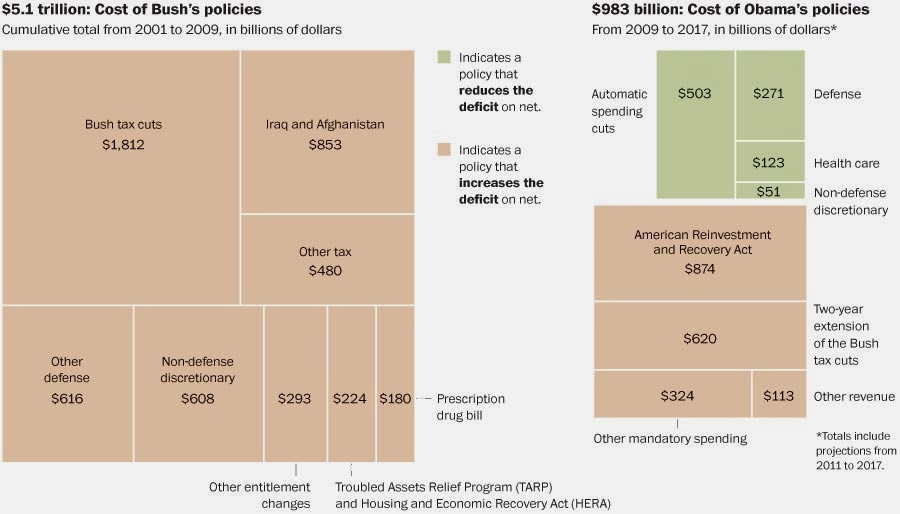
Perhaps the biggest piece of evidence that conservative Republicans only care about deficits as a political wedge is that they ran up historic deficits from 2001 to 2008 and did not rise one dollar in revenue to pay the deficit down. Mitt Romney has a deficit "reduction" plan, full of accounting gimmicks it will increase the deficit by at at least $3 trillion dollars while cutting the safety net and buying the newest toys for the military.

The Debt Increase Under Obama Is Largely A Result Of Bush-Era Policies

Trump on Romney: ‘He’d Buy Companies, He’d Close Companies, He’d Get Rid Of Jobs’

Sunday, May 20, 2012

Patriotism 101: Why Are Conservative Republicans Lying To America About Food Stamps and Unemployment


Patriotism 101: Why Are Conservative Republicans Lying To America About Food Stamps and Unemployment

In a recent Wall Street Journal op-ed, Robert Barro dismisses Agriculture Secretary Tom Vilsack’s claim that every dollar spent on food stamps generates $1.84 of economic activity.  Barro claims Secretary Vilsack’s “Keynesian” estimate conflicts with “regular” economics, which he says predicts that increasing transfer payments like food stamps and unemployment insurance (UI) would lead to a decline in economic activity and a fall in employment because they would “motivate less work effort by reducing the reward from working.”

Contrary to Barro’s assertion, however, the Secretary is in good company appealing to Keynesian multiplier analysis under current economic conditions, and Barro’s assessment is implausible.  For example, the Congressional Budget Office has estimated that transfer payments to individuals like the increase in food stamp benefits and additional UI compensation of the 2009 Recovery Act generate between 80 cents and $2.10 for each dollar spent when the Federal Reserve holds short-term interest rates as low as possible (see Table 2 here).  Barro says “there is zero evidence” that deficit-financed transfers increase economic activity and boost employment;” CBO explains why, taken as a whole, the evidence says they do.

Circumstances matter.  When the economy is humming along on all cylinders and unemployment is very low – think the late 1990s – deficit-financed increases in food stamps and UI would not increase economic activity or boost employment.  The multiplier would be essentially zero because the Federal Reserve would raise interest rates in response.  Any rise in demand stimulated by the increase in transfers would be offset by the fall in demand due to higher interest rates.  Barro’s concern about work disincentives could come into play if transfers were exceedingly generous.

That’s not where we are now.  Higher interest rates due to Fed tightening will not likely be a concern anytime soon.  Instead, we face a long period of high unemployment and excess productive capacity.  These are just the circumstances in which transfers will most likely be effective in stimulating demand and creating jobs.

Food stamp and UI recipients spend most of any increase in income they get, and they spend it quickly.  That means more spending at local businesses and more orders for those businesses’ suppliers.  The additional spending generates income for local businesses and their suppliers, and the boost to demand multiplies through the economy.  With nine unemployed workers for every two job openings and businesses generally operating well below full capacity, constraints on expanding production and employment to meet the increased demand should be minimal.  Treasury borrowing costs will continue to be low and we will increase the odds that a real economic recovery will take hold.

I wish we were at a point where further deficit-financed spending would be counterproductive because growth is strong and full employment is in sight.  But, we’re clearly not there yet and it’s bad economic policy – regular or irregular – to pretend otherwise.

 We do live in a free market society - at least for those in the middle-class and below ( in other words not in the same economic class as George W. Bush and Mitt Romney). When people spend their very small government benefits those dollars do not disappear down a black hole. And when people do get back on their feet - and most Americans do eventually - they pay back into the system and start putting more money in the pockets of American business. At no time in this cycle is there much incentive not to seek work. Having a safety net to provide some protection against ending up living under a bridge is hardly incentive to live off gov'mint benefits. Those benefits are measly at best.

Anti-American Propaganda Channel Fox News Spreads Romney's Dubious Talking Point On Women's Job Losses

The National Review’s fake plagiarism scoop - Updated: After falsely accusing Elizabeth Warren of plagiarism, the conservative magazine apologizes. The Biggest wuss in Massachusetts Scott brown (R) is still using false and distorted claims in his mail campaign about Warren to rise money.

Women for Obama